
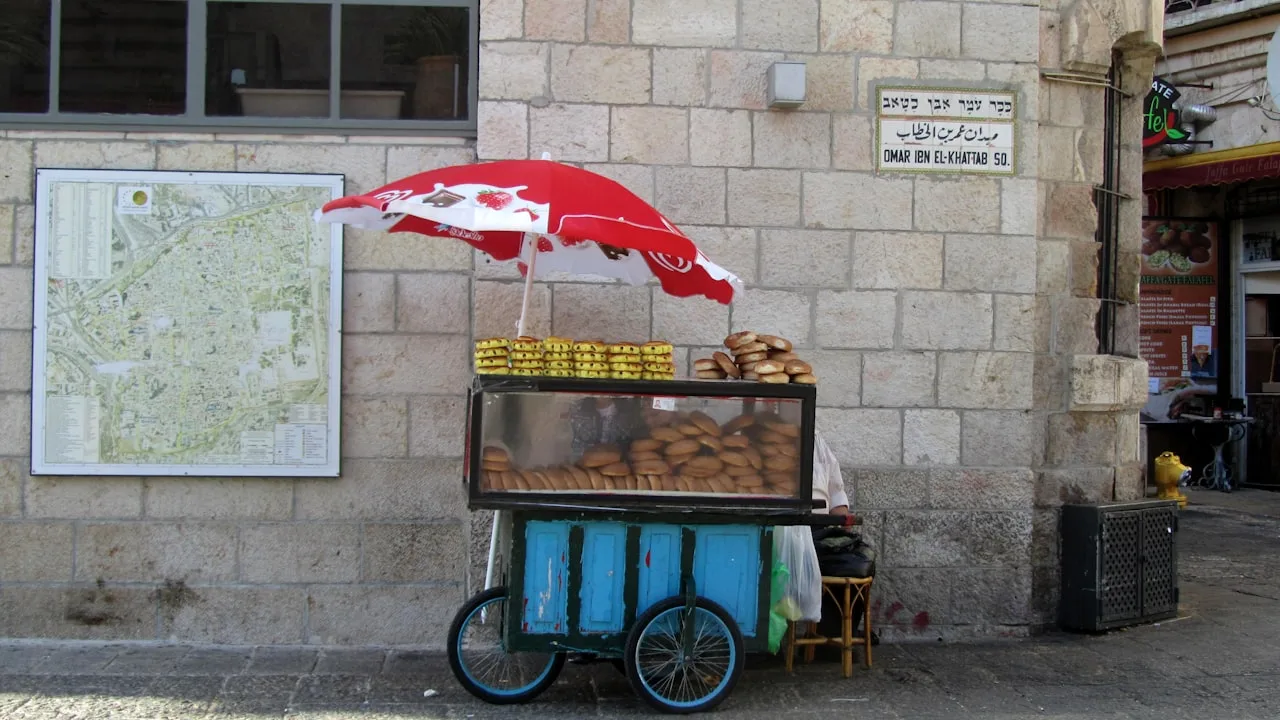
There is a bread being sold this morning on a wooden cart in the Old City of Jerusalem. It is ring-shaped, dusted heavily with sesame seeds, slightly longer than it is wide, its crust golden and cracking at the edges. The man pushing the cart calls out as he goes — ka’ak, ka’ak — and schoolchildren and shopkeepers and the occasional tourist stop to hand over a few shekels for one. They eat it walking, or they tuck it under an arm and carry on. Nobody remarks on it. It is simply there, as it has always been.
This same morning, in a bakery in Warsaw, someone is boiling rings of yeasted dough in a wide pan before sliding them into a hot oven. In a village in Gozo, a family is baking a large ring of bread crusted with sesame and almonds for the Lenten table. In Istanbul, a street vendor loads a tray with simit, the sesame-ringed bread that has been sold on Ottoman and post-Ottoman street corners for longer than anyone has kept records.
The same shape. The same seeds. The same hole at the centre. Separated by thousands of miles and several centuries of diverging history, and yet unmistakably related in a way that invites a question: what if these were not parallel inventions, but chapters in a single, very long story?
The ka’ak appears in Arabic culinary records earlier than almost any other specific bread form. It surfaces in the Kitab al-Tabikh, the oldest surviving Arabic cookbook, compiled in the 10th century by Ibn Sayyar al-Warraq. It appears without a detailed recipe — which tells you something. A food that needs no explanation in a culinary text is a food that already belongs to everyone, a thing so common it would be faintly absurd to describe it from scratch. The ka’ak was already, by the 10th century, simply part of the furniture.
Three hundred years later, a 13th-century Syrian cookbook called the Kitab al-Wusla ila al-Habib, compiled in Aleppo under the Ayyubid dynasty, gives three separate recipes for ka’ak. One of them contains an instruction that would, many centuries later, produce a small but significant debate among food historians. It says, in effect: take these ring-shaped doughs, place them on a dowel, boil them in water, and then bake them.
Boil and then bake. A ring of dough. Sesame on the outside.
That is, with very few modifications, a bagel.
The ka’ak itself encompasses a vast family of baked goods across the Arab world — sweet cookies at Eid, date-filled pastries in Palestine, the dry anise-and-sesame rings of North Africa, the soft teardrop-shaped bread of Lebanon sold from handbag-like rings on poles. The word simply means cake in classical Arabic, and it functions as a generous category rather than a precise specification. But the Levantine street version — the large ring, the sesame crust, the light and airy interior — is what most people picture when they hear it, and it is that form which draws the most interesting historical threads.
Malta was an Arab island for two hundred years. Between 870 and 1091 AD, the archipelago was governed by Arab rulers, settled by Arab and Berber populations, and shaped in ways that have never entirely disappeared. The Maltese language, uniquely among all languages in Europe, is a Semitic tongue written in Latin script. Its Arabic roots are not loan words absorbed at the periphery of a culture. They are the bones of the language, the structures through which Maltese people have thought and spoken and argued for a thousand years.
Food does not escape this. It rarely does. When a culture occupies a place for two centuries, it brings its seeds, its livestock, its agricultural practices, and its recipes. The Arab agricultural revolution that transformed the Mediterranean — citrus, cotton, sugarcane, new varieties of wheat, new irrigation techniques — came through exactly this kind of extended presence.
And it brought the ring bread.
The qagħqa tal-Appostli, the Apostles’ ring bread, is still baked in Malta today, most particularly during Lent and Holy Week. It is a large, soft-crumbed bread with a slightly crunchy crust, generously covered in sesame seeds, with whole almonds pressed into the surface. It is sold at the end of village processions for Our Lady of Sorrows, carried home under the arm, eaten at the family table with butter and broad beans and ġbejniet, the soft Maltese sheep’s cheese. Families buy one large ring between them. Children make the walk home considerably shorter than it should be by removing the almonds one by one along the way.
Compare this to the Levantine ka’ak: the ring shape, the sesame coating, the bread’s role in communal and ritual life, the way it is carried and sold and shared. The parallel is not incidental. Malta’s Arab century is the most obvious, most direct explanation for why a ring bread studded with sesame seeds embedded itself so deeply in Maltese food culture that it persists, recognisably, a thousand years later. The qagħqa is not a curiosity. It is a piece of evidence.
The Arab expansion across the Mediterranean did not stop at Malta. Between the 6th and 9th centuries, Arab forces moved along the southern coastline of Europe, establishing strongholds in Sicily, Sardinia, and the Italian mainland. The city of Bari, in the heel of the Italian boot, became one of their principal bases. Arab Bari lasted from 847 to 871 AD — a shorter occupation than Malta’s, but long enough to leave culinary traces that are still visible today.
The most interesting of those traces, in the context of this particular story, is the tarallo. The tarallo is a ring-shaped bread from Puglia, the region of which Bari is the capital. It is boiled before it is baked. It has been made in roughly this form for as long as Pugliese culinary records exist. It sits in the same family as the ka’ak and, eventually, the bagel — and it exists in a place where Arab food culture was actively present during the same period it was transforming the rest of the southern Mediterranean.
This is where Palestinian food writer Reem Kassis enters the story. In research published in 2021, Kassis traced the proposed route by which the Arab ring bread might have travelled north into Poland, where the bagel as we know it would eventually take shape. The proposed carrier was an unlikely one: a 16th-century Italian noblewoman.
Bona Sforza was born in Bari in 1494. In 1518, she married Sigismund the Old and became Queen of Poland and Grand Duchess of Lithuania, arriving in Kraków with her Italian household, her tastes, and her culinary background. It is in Kraków, in 1610, that the first written mention of the bajgiel — the bagel, by name — appears in the regulations of the Jewish community. Kassis argues that the connection between Bona Sforza’s Pugliese origins and the appearance of a boiled ring bread in Kraków a century later is more than coincidental.
She also notes something about flour. Rye was the dominant grain of eastern Europe. And yet the Polish obwarzanek — the direct precursor to the bagel — was made with wheat, a grain that originated in the Eastern Mediterranean and was spread across the regions touched by Arab trade and conquest. The wheat itself may be a kind of fingerprint.
It is a compelling argument, and it should be held with appropriate care. Food historian Maria Balinska, whose book The Bagel: The Surprising History of a Modest Bread is the most thorough study of the subject, raises the connection between Bona Sforza and the bagel but ultimately pulls back from it, pointing out that boiled ring breads were being made in Kraków a century before the queen arrived. Other historians trace the bagel’s immediate lineage to the German pretzel, adapted by Jewish bakers in Poland who were restricted from baking ordinary bread and developed their own distinct form. Both accounts are plausible. Neither entirely rules out the other.
What Kassis’s argument does, at its best, is open the possibility that the story is longer and more connected than the Polish-Jewish account alone suggests — that the technique of boiling a ring of dough before baking it may have travelled, in stages, from Arab Syria through Arab southern Italy and into the kitchens of medieval Poland, arriving by routes that are now partially obscured but not entirely invisible.
No account of the bagel’s history can entirely avoid the most famous origin story, even though it is almost certainly wrong.
The legend runs as follows. In 1683, the Ottoman army besieged Vienna. The city was on the point of falling when Jan Sobieski III, King of Poland, led a relief force and broke the siege at the Battle of Vienna. In gratitude, a Viennese baker — knowing of the king’s love of horses — created a ring-shaped bread in the form of a stirrup. In German, a stirrup is a Steigbügel, shortened to bügel, which became bagel. The bread was named after its shape, and its shape was named after the king’s horsemanship.
It is a tidy story. It has the structure of a good anecdote: a hero, a battle, a grateful craftsman, a neat linguistic explanation. It also falls apart on dates. Bagels are documented in Polish Jewish community records in 1610 — seventy-three years before the battle. The bread existed long before the siege, under precisely the name that the legend claims was invented to commemorate it.
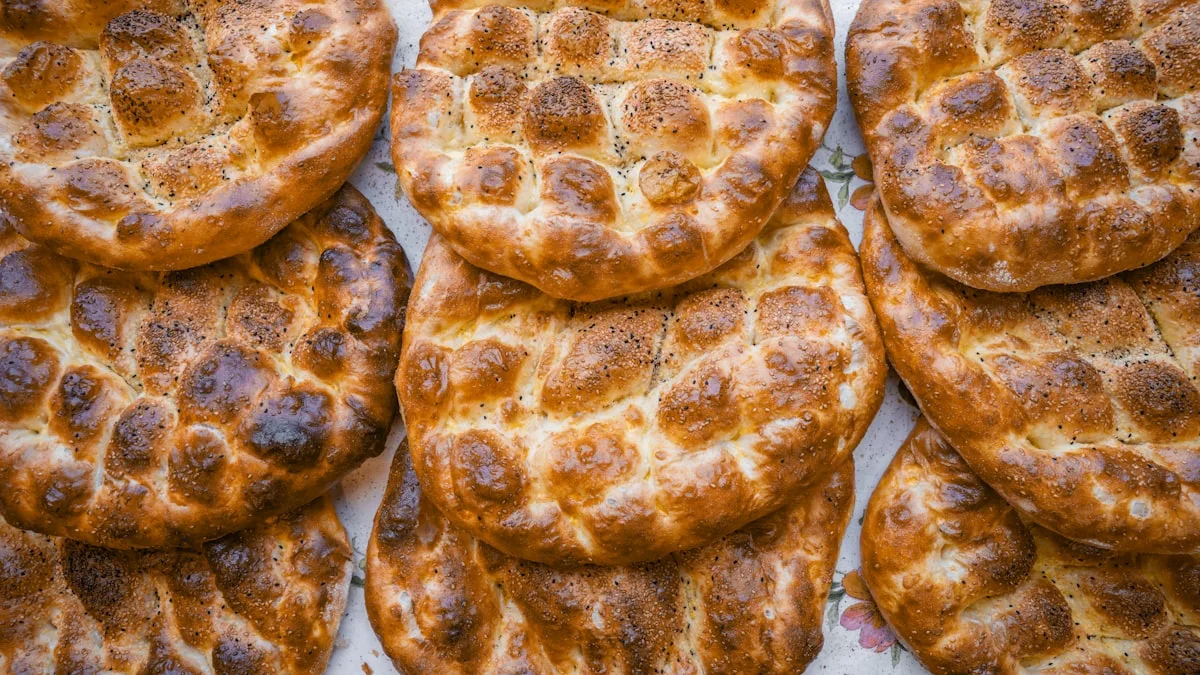
What the legend does capture, however inadvertently, is the real presence of the Ottoman world in this story. The Turkish simit — a ring of dough coated in grape molasses and then sesame seeds, baked crisp and sold on street corners — belongs unmistakably to the same family as the ka’ak, the qagħqa, and the bagel. Early 19th-century paintings of Istanbul daily life show simit sellers on the streets with their characteristic stacked trays, and the breads they carry would not look out of place in early photographs of bagel vendors on the Lower East Side of New York.
The Ottoman Empire was itself a conduit for Arab culinary traditions moving westward. The simit’s probable ancestry lies in the same Levantine ring bread tradition as everything else in this story. The irony of the Vienna legend is that the Ottomans, cast as the threat that inspired the bagel’s creation, were probably carrying bread in their supply trains that was closer kin to the bagel than the Viennese stirrup ever was.
None of this diminishes what happened in Poland, and it would be a mistake to read this story as an attempt to displace Jewish cultural ownership of the bagel. What Jewish bakers did with the ring bread — in the specific conditions of medieval Poland, under specific legal restrictions, within specific community traditions — made something genuinely new.
In Medieval Europe, Jewish communities were frequently forbidden from baking ordinary bread, which the Church considered a sacred food. Poland was more tolerant than most European nations, and Jewish bakers gradually won the right to bake, but the bread they produced had to be distinct — different enough that Christian customers would not confuse it with the bread from Christian bakeries. Boiling the dough first achieved exactly this. It produced a different texture, a different crust, a different character. It was not ordinary bread. It was something else.
That something else became woven into Jewish communal life in ways that went far beyond sustenance. Bagels were given to women after childbirth as a gesture of protection for the newborn. They appeared in mourning rituals. They were sold by vendors on poles and strings in the streets of Kraków and Warsaw, familiar and everyday and charged with meaning simultaneously. The great Yiddish writer Isaac Bashevis Singer remembered the bagel sellers of Warsaw from his childhood in 1908 alongside the herring sellers and the fruit sellers and the sellers of hot peas, simply present, simply there.
When Jewish communities emigrated to the United States in the late 19th and early 20th centuries, the bagel came with them. It spent decades as a food of the immigrant Jewish enclave, almost invisible to the wider American public. Then, in the second half of the 20th century, it became something else entirely: one of the most commercially successful bread products in the world, mass-produced, pre-sliced, available in dozens of flavours, stripped of most of the qualities that once made it specific.
That transformation is its own story. But the bagel that arrived in America was the product of everything that had come before — the ring bread of the Arab world, the boiling technique documented in a 13th-century Syrian cookbook, the possible passage through Puglia, the adaptation by Jewish bakers in a city on the Vistula. Every step of the journey left something in the bread.
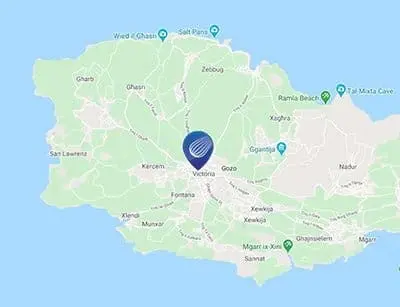
Return, for a moment, to Gozo on a Saturday evening in Holy Week. A family walks home from the procession of Our Lady of Sorrows through streets that smell of incense and limestone and the faint sweetness of almonds. Someone is carrying a qagħqa tal-Appostli, a large ring of sesame bread, still warm. It will be eaten at the kitchen table with broad beans and cheese and probably a glass of something local. The almonds, if there are any left, will be saved for the children.
This bread has been here, in roughly this form, since the Arab century. The Maltese didn’t invent it, exactly, but they received it and they kept it and they made it their own in the way that all living food traditions work — not through pure invention, but through continuous practice, through the accumulated decisions of everyone who ever baked one and decided it was worth baking again.
While the bagel was making its extraordinary journey north and west — through Puglia, through Kraków, through the Jewish quarters of Warsaw, across the Atlantic to the Lower East Side, and eventually into the freezer section of supermarkets from Auckland to Aberdeen — the qagħqa stayed put. It became a Lenten bread, a village bread, a bread for the walk home from church. It did not travel. It settled.
There is a kind of quiet stubbornness in that, and it is worth respecting.
The hole in a ring bread is, practically speaking, useful. It allows even cooking. It allows the bread to be threaded onto a pole or a string for transport and display. It gives street vendors a way to carry dozens of breads without a basket. These are real advantages, and they almost certainly explain why the form caught on and spread.
But a hole is also a space. And into that space, different cultures at different moments have poured different meanings. In medieval Jewish Poland, it was a bread of circumscribed identity — permitted where ordinary bread was not, shaped by restriction into something that became a source of pride. In Ottoman Istanbul, it was a street food, democratic and ubiquitous. In Arab Jerusalem, it was and is a daily bread, sold from carts by men whose call carries through the stone corridors of the Old City. In Malta, it is a ritual bread, seasonal and communal, connected to grief and spring and the specific smell of a village church on a March evening.
The bagel did not come from one place. The ka’ak does not belong to one people. The qagħqa is not merely a Lenten footnote. They are all part of the same long conversation about what bread can carry — practically, culturally, historically — when it is made in a ring and passed from hand to hand across the length of the Mediterranean.
Malta has been sitting at that crossroads for a thousand years. It has the bread to prove it.
The qagħqa tal-Appostli is traditionally baked during Lent in Malta and Gozo, most commonly in the weeks approaching Easter. If you would like to make your own, look for a recipe that uses olive oil in the dough — this is the older, more distinctly Mediterranean preparation. The sesame coating should be generous. The almonds on top are non-negotiable.

At Med.kitchen, our passion lies in crafting exceptional culinary experiences through our online platform. We specialise in sharing a wealth of knowledge via articles, recipes, courses, and online mentoring, aiming to inspire both novice and seasoned chefs alike. Our focus has shifted from private dining to being an online source of gastronomic inspiration, allowing you to explore and refine your culinary skills from the comfort of your home..