
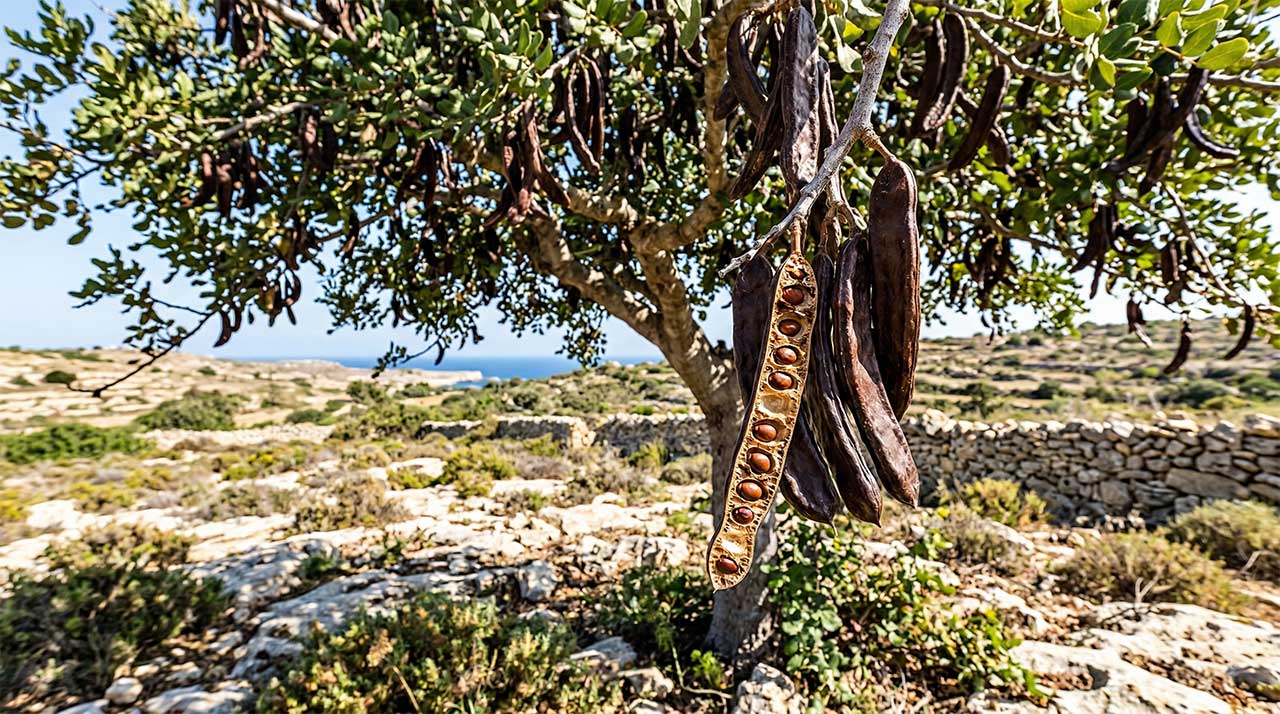
There are ingredients that arrive with fanfare, and there are ingredients that remain at the edges of memory, quietly doing their work for centuries. Carob belongs to the second category. In Malta, it does not usually announce itself as a grand emblem of national food culture, yet it sits firmly in the landscape and in the cupboard. You see it in the dark pods hanging from roadside trees, in the syrup kept for coughs and sore throats, and in those older culinary habits that blur the line between nourishment, remedy, and thrift. In recent years, much has been made of carob’s ancient pedigree and its supposed connection to the carat. Interesting as that is, Malta offers a better place to begin, because here the carob has remained something lived with, not merely something written about.
That matters, because carob in Malta has never been only one thing. It is a tree suited to the islands’ dry conditions and poor soils, which partly explains its long presence in the rural environment. It is also a foodstuff, though often in forms that speak more of ingenuity than indulgence. The best known of these is ġulepp tal-ħarrub, the dark, thick syrup made from the pods, a preparation still associated with household treatment for coughs and colds. Friends of the Earth Malta also notes karamelli tal-ħarrub, described as the only sweets traditionally permitted during Lent, which places carob within a specifically Maltese rhythm of abstinence, season, and religious custom. That alone tells you a great deal. This is not an ingredient historically tied to luxury. It belonged instead to a world in which sweetness had to justify itself and in which usefulness counted for a great deal.
There is something deeply Mediterranean in that. Carob is a crop of hard climates, a tree that makes sense in places where water is not abundant, where summers are severe, and where agriculture has always required patience rather than optimism. Across the Mediterranean, carob has appeared as fodder, flour, sweetener, emergency sustenance, and trade commodity. Its usefulness is broad, but its cultural character is even more interesting. It is not glamorous in the way that olives are glamorous, nor celebratory in the way that grapes can be. Carob belongs to a more restrained register. It speaks of continuity, storage, adaptation, and the old instinct to waste very little. Malta, perhaps because it is small and exposed and historically accustomed to making a lot from limited means, preserves that logic particularly clearly.
The more romantic story of carob also continues to draw attention, and one can see why. The familiar claim is that the carob seed helped give us the carat via the Greek ‘keration’, meaning ‘little horn’ or ‘carob seed’, and through the long use of seeds as small units of weight in trade. It is an elegant idea, and the elegance is part of its appeal. A humble seed, dry and dark and Mediterranean, somehow crossing into the worlds of goldsmiths, jewellers, and systems of exchange. It suggests a civilisation in which ordinary natural forms could become instruments of precision. That is a lovely thought, and not an empty one. The modern metric carat is indeed fixed at 200 milligrams, and the linguistic relationship between carob and carat is well established.
What is less secure is the tidy explanation often attached to it, namely that carob seeds were used because they were naturally uniform in weight. That story has been repeated for years because it feels almost too perfect to resist. Yet a 2006 paper in Biology Letters examined the matter directly and found that carob seeds are not unusually constant at all. Their variability was close to the average found across many other plant species. In other words, the famous certainty of the carob seed appears to be more cultural than biological. That does not diminish the story. If anything, it improves it. The real lesson is not that nature conveniently handed Mediterranean traders a flawless measuring device. It is that people built systems of trust, habit, and meaning around a material that seemed persuasive enough to serve. That is a far more human explanation and a far more Mediterranean one as well.
This is why the modern rediscovery of carob can feel slightly incomplete. When people encounter it now, they often meet it as powder, gum, sweetener, or health ingredient. The seed yields locust bean gum, widely used by the food industry as a stabiliser and thickener, while the pod has found new life in the language of functional foods and chocolate substitutes. That is true as far as it goes, but it can flatten the older cultural reality. Carob was never interesting only because it was nutritious or versatile. It mattered because it answered needs. It could be stored, transformed, boiled down, carried across lean periods, and made to perform several roles at once. In Malta, where ġulepp tal-ħarrub remains culturally legible as both food and remedy, that older reality has not vanished entirely under the pressure of modern packaging.
And perhaps that is where carob becomes most interesting. It reveals how Mediterranean food culture has always worked across several registers at once. A plant can be practical and symbolic. It can be medicinal and culinary. It can belong to the field, the market, the storeroom, and the imagination all at once. Carob in Malta demonstrates this beautifully. It is a tree of the roadside and the valley but also of the pantry. It is tied to older domestic knowledge but also to industrial food systems through locust bean gum. It is part of religious food memory but also part of a much wider Mediterranean history of drought, trade, and adaptation. The pod is modest, but the network of meanings around it is not.
What carob asks of us now is not reverence and certainly not trend-driven rediscovery. It asks for attention. It asks us to notice that some of the most revealing ingredients in Mediterranean food culture are not the celebrated ones but the patient ones. The ones that remain in the background, half-remembered, are still rooted in local practice. In Malta, carob has never needed to become fashionable in order to remain significant. It has persisted in the landscape and in habit, which may be a more durable form of cultural importance anyway.

At Med.kitchen, our passion lies in crafting exceptional culinary experiences through our online platform. We specialise in sharing a wealth of knowledge via articles, recipes, courses, and online mentoring, aiming to inspire both novice and seasoned chefs alike. Our focus has shifted from private dining to being an online source of gastronomic inspiration, allowing you to explore and refine your culinary skills from the comfort of your home..