
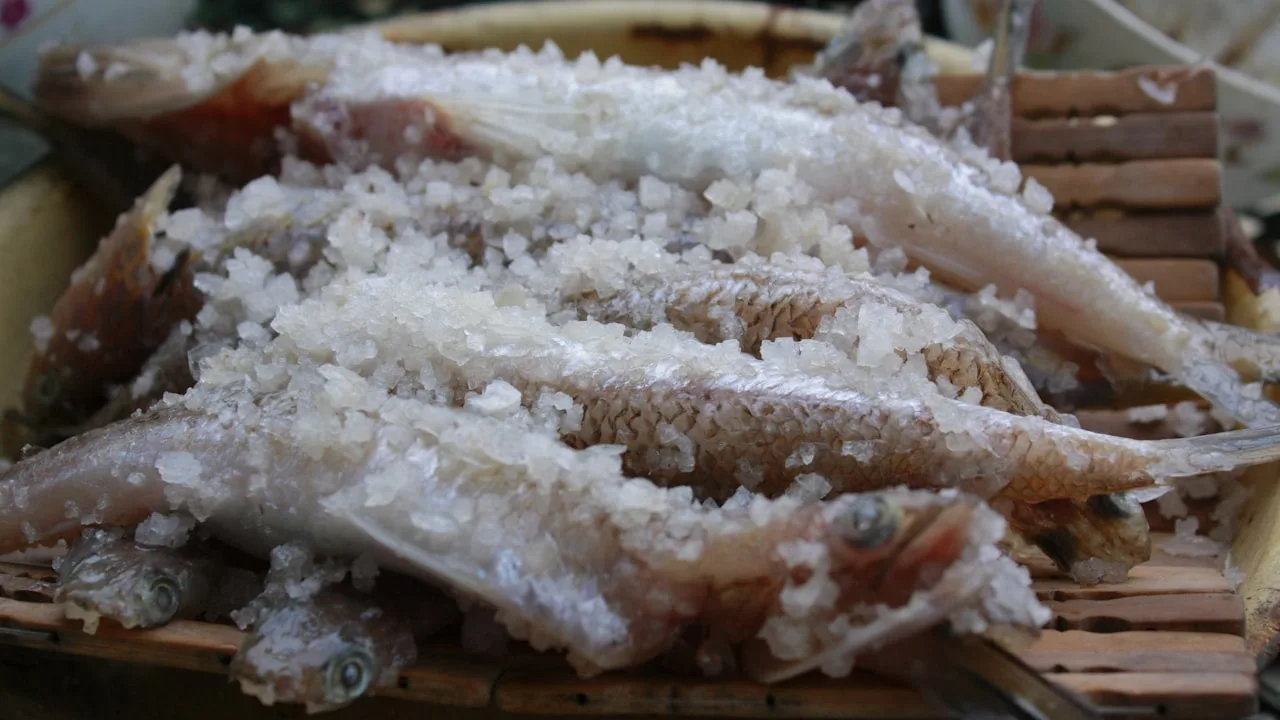
There is a moment, if you have ever walked through a market in Lisbon, Naples, or Nice, when you round a corner and your nose registers something before your eyes do. It is sharp, briny, almost aggressively marine. Then you see it: stiff, pale, almost architectural slabs of dried salt cod stacked like timber. That is baccalà. Or bacalhau. Or morue. The name changes depending on which coast you are standing on, but the fish is the same, and so is the quiet authority it carries in the kitchen.
Fresh cod, by contrast, asks almost nothing of you. It is mild, flaky, forgiving. You can poach it gently on a Tuesday evening and have something genuinely pleasant on the table in twenty minutes. Salt cod asks considerably more. It requires patience, planning, and a willingness to engage with an ingredient that has been fundamentally transformed from what it once was. That transformation is the interesting part.
When you pack raw cod in salt and leave it to cure, two things happen in parallel. First, osmosis draws moisture out of the flesh. Second, and more consequentially, the proteins in the fish begin to denature and restructure. The muscle fibres tighten and compress. The texture shifts from the soft, almost gelatinous quality of fresh fish into something closer to dense, fibrous cloth. What you are left with, once the drying process is complete, is an ingredient with perhaps fifteen to twenty percent of its original moisture content.
This is not simply preservation by another name. The salt does not merely pause the clock on fresh cod. It rewrites what the ingredient fundamentally is. The flavour concentrates, develops a depth and intensity that fresh cod cannot produce regardless of how it is cooked. The texture, once properly rehydrated through long soaking, becomes uniquely yielding yet substantial, with a chew that has no real equivalent in fresh fish cookery. You are dealing with a different ingredient, one that happens to share a biological origin with the mild white fillet in your supermarket chiller.
Salt cod’s dominance in Mediterranean cooking is not a culinary accident. It is the direct result of a specific set of historical, geographical, and economic pressures that converged in the fifteenth and sixteenth centuries. The Portuguese were fishing the Grand Banks off Newfoundland by the early 1500s, and they needed a way to bring enormous quantities of Atlantic cod back to Lisbon without refrigeration. Salting and air-drying solved that problem with elegant efficiency.
The preserved fish could be shipped across the Atlantic, stored in warehouses for months, and transported inland across the Iberian Peninsula and into the broader Mediterranean trading networks. For populations that were often poor, frequently Catholic and therefore subject to fish-eating obligations on Fridays and throughout Lent, and often far from any coastline, baccalà became a reliable, affordable, nutritionally dense staple. It was not exotic. It was practical. The cooking traditions that built up around it reflect that practicality.
Portugal alone is said to have over three hundred distinct recipes for bacalhau, which is either a remarkable act of culinary creativity or a sign of how deeply embedded the ingredient became in the national identity, probably both. Italy’s baccalà alla vicentina, slowly braised in milk and aromatics, is a dish from landlocked Vicenza, which tells you everything about how salt cod made geography irrelevant. The Spanish brandada, the French brandade de morue, the Provençal salt cod fritters. These dishes did not emerge from abundance. They emerged from necessity, and they outlasted the necessity by centuries because they are genuinely good.
Ask most home cooks about baccalà and they will mention the soaking. They are right to. Proper rehydration is where the ingredient is either rescued or ruined, and the details matter more than people tend to assume. The standard guidance is forty-eight hours minimum in cold water, with the water changed every eight to twelve hours. For thicker pieces, seventy-two hours is not excessive.
Cold water is not a suggestion. Warm water accelerates bacterial activity and, more importantly, begins to cook the outer proteins of the fish before the salt has fully migrated out. The result is a piece of baccalà that is still aggressively salty at its core and texturally uneven on its surface. The patience the ingredient demands during soaking is genuine; there is no shortcut that produces the same result. This is, frankly, one of the things that separates people who cook baccalà regularly from those who try it once and do not return to it.
After soaking, taste a small piece of the raw fish. It should be pleasantly seasoned rather than mouth-puckeringly salty. If it is still too aggressive, change the water and continue. The fish will tell you when it is ready, provided you are paying attention.
Understanding how baccalà behaves during cooking is easier once you accept that it is a concentrated ingredient. It has already been through something. The proteins have already been worked hard by the salt and the drying process. This means it responds well to gentle, slow methods: braising in olive oil or milk, baking at moderate temperatures, folding into potato-based preparations where the starch softens its intensity. It is less forgiving of high-heat, rapid methods because the structure can seize and become rubbery in ways that fresh cod simply does not.
Brandade is perhaps the most instructive example of working with the ingredient’s logic rather than against it. You poach the soaked fish gently, then work it with warm olive oil and, depending on tradition, warm milk and cooked potato. The point is to incorporate fat into the fibrous, broken-down flesh in a way that produces something smooth, almost spreadable, deeply savoury. It is not trying to make baccalà taste like fresh fish. It is using what baccalà actually is, an intensely flavoured, structurally unusual protein, to create something that fresh cod could never produce.
One question that follows naturally from all of this is why baccalà remains so central to Mediterranean cooking now that refrigeration has made fresh fish available almost everywhere. The honest answer is that it persists because it is irreplaceable rather than merely traditional. The flavour profile it contributes to a dish cannot be replicated by salting fresh cod at home for a few hours, or by cooking fresh cod down harder. The curing and drying process creates chemical changes that are cumulative and time-dependent. You cannot rush five hundred years of culinary knowledge into an afternoon.
There is also something worth considering about the cultural weight these dishes carry. The recipes built around baccalà are not preserved out of nostalgia alone. They are preserved because they genuinely work, because they are satisfying in a way that reflects real culinary intelligence developed over generations of constrained cooking. The Vicentini did not braise salt cod in milk because fresh fish was unavailable and they had no choice. They refined that technique until it was excellent, and then they kept it.
Fresh cod and salt cod are not rivals occupying the same culinary space. They occupy different spaces entirely, and acknowledging that distinction is the first step towards cooking either of them well. The salt does not degrade the fish. It translates it into another register, one that has proven, over half a millennium of continuous use, to have a great deal worth saying. Whether modern kitchens are still listening carefully enough is perhaps the more interesting question.

At Med.kitchen, our passion lies in crafting exceptional culinary experiences through our online platform. We specialise in sharing a wealth of knowledge via articles, recipes, courses, and online mentoring, aiming to inspire both novice and seasoned chefs alike. Our focus has shifted from private dining to being an online source of gastronomic inspiration, allowing you to explore and refine your culinary skills from the comfort of your home..