
Preserved lemons and fresh lemons are not interchangeable, and pretending otherwise is how you end up with a tagine that tastes like a cleaning product or a salad dressing that makes people politely put down their forks.
This is a comparison that comes up more than you’d expect, particularly as preserved lemons have edged their way from specialist Middle Eastern and North African grocers into the mainstream. They’re on supermarket shelves now, appearing in recipes that once wouldn’t have gone near them. That’s broadly a good thing. But it’s also created a tendency to reach for them whenever a recipe calls for “something lemony”, which is a misunderstanding of what they actually do.
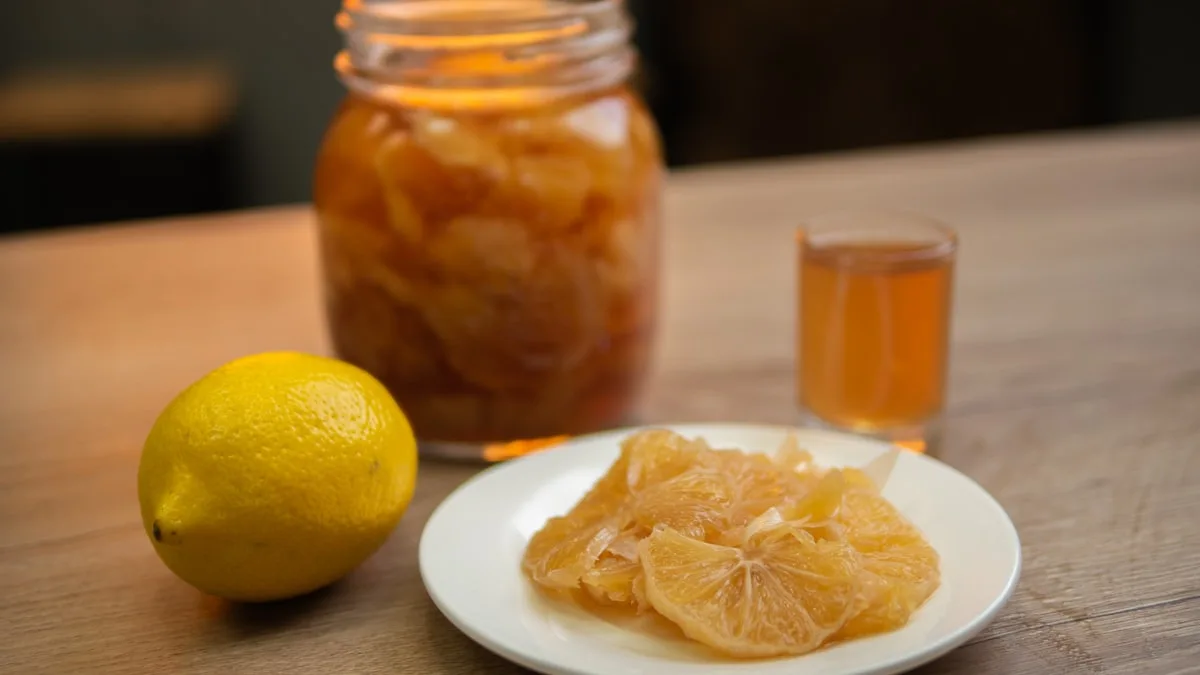
Before comparing the two, it helps to be precise about what preserved lemons are. They are lemons, typically quartered or halved, packed in salt and left to ferment in their own juice for anywhere from three weeks to several months. The result is a softened, deeply aromatic ingredient in which the bitterness of the pith mellows, the acidity transforms, and the rind becomes the star. Most recipes only use that rind, discarding the pulp entirely.
The flavour is hard to describe cleanly if you haven’t tried it. There’s citrus, yes, but it’s low, complex and almost floral. There’s salt, obviously. There’s a fermented depth that sits somewhere between brine and umami. It is not a sharper or more intense version of fresh lemon. It is a fundamentally different ingredient that happens to share a base material.
Fresh lemon does things preserved lemon simply cannot. The first is brightness. When you squeeze half a lemon over grilled fish just before serving, you’re adding acidity and fragrance that lifts the entire dish in a way that’s immediate and clean. That lift is entirely dependent on volatile aromatic compounds that disappear during fermentation. A preserved lemon doesn’t lift. It anchors.
The second is precision. Fresh lemon juice allows you to adjust acidity in real time: a squeeze here, a little more there, tasting as you go. It integrates quietly into sauces, vinaigrettes and marinades without drawing attention to itself. It is a supporting character that improves the whole without announcing its presence. Preserved lemon, by contrast, is always noticeable. That’s not a flaw, but it does mean it isn’t a neutral tool.
Any dish where you want fresh, high-frequency citrus flavour should use fresh lemon. Think lemon curd, lemonade, a quick pasta with capers and butter, hollandaise, lemon drizzle cake, or a squeeze over avocado. The list is long. These applications rely on freshness as a defining quality, not a coincidence.

Preserved lemons come into their own in long-cooked, heavily spiced or salt-forward dishes where you want complex citrus depth rather than brightness. The classic examples are Moroccan tagines, slow-braised lamb or chicken with olives, roasted vegetables with herbs, and grain salads where the lemon becomes part of the dressing’s architecture rather than its finishing touch.
They work particularly well when the dish already has time and heat involved. Slow cooking softens preserved lemon further and allows its flavour to permeate the entire pot. Fresh lemon squeezed into a tagine at the start of a two-hour braise just turns bitter and flat. The acid breaks down, the volatile aromatics vanish, and you’re left with very little. Preserved lemon, having already been through its transformation, holds up and continues to contribute.
They’re also excellent in compound butters, scattered through roasted cauliflower, stirred into hummus, blended into dips, or finely chopped and added to a herb sauce or chermoula. Anywhere you want lemon flavour that is persistent, savoury and layered rather than sharp and transient: that’s preserved lemon territory.
Here’s where recipes can quietly mislead you. A growing number of modern cookbooks suggest substituting one for the other with minor adjustments, as though the difference is primarily one of intensity. It isn’t. The flavour profiles are structurally different, not just quantitatively different. Substituting fresh lemon zest and juice for preserved lemon in a tagine will give you something edible, possibly pleasant, but it won’t replicate the original dish’s character. The fermented depth simply isn’t there.
The reverse is more complicated still. Using preserved lemon in a dish designed for fresh lemon will often make it taste strange in a way that’s difficult to diagnose. A lemon tart made with preserved lemon rind instead of fresh zest will have a briny, fermented quality that most people will find confusing. The dish hasn’t failed exactly, but it’s going somewhere the recipe never intended.
The practical advice here is to resist the temptation to treat them as members of the same family who can cover for each other in an emergency. They can approximate each other in some contexts. In the ones that matter, they can’t.
There is a particular kind of cooking instinct, usually found in people who’ve recently discovered a new ingredient, that involves adding it to everything. Preserved lemons are genuinely exciting when you first encounter them. The temptation to work them into dishes that didn’t ask for them is real and understandable. It’s also worth resisting.
If a recipe calls for fresh lemon and is built around that brightness, preserved lemon will change the dish’s register without necessarily improving it. A simple roast chicken with lemon and herbs does not need fermented lemon’s complexity. A vinaigrette for a light summer salad doesn’t need preserved lemon’s brininess. A quick pan sauce doesn’t need the extra time and fuss of finely mincing rind when a squeeze of fresh lemon would do the job in ten seconds.
The question to ask is not “Could I add preserved lemon here?” But “is this dish asking for what preserved lemon actually provides?” Complexity for its own sake is a cul-de-sac in cooking. The best use of any ingredient is the one that serves the dish rather than impresses the cook.
When you’re deciding which to reach for, run through a few quick questions. Is this dish cooked for a long time at high heat? Does it already have salt-forward, spiced or fermented elements? Is lemon flavour meant to be a persistent background note rather than a finishing brightness? If yes to most of those, preserved lemon is likely the right call.
Is the dish light, quick and reliant on fresh flavour? Is lemon’s role to add acidity and lift rather than depth? Is the preparation simple enough that adding a complex ingredient would distort rather than enrich? Fresh lemon, then. Full stop.
If you’re genuinely unsure, there’s a reasonable middle path: use fresh lemon as the primary ingredient and add a small amount of finely minced preserved lemon rind to introduce some complexity. This works particularly well in dressings and marinades. It’s not a substitute in either direction; it’s a layering technique. Done carefully, it can be quite good.
Yes, and it’s straightforward. Quarter lemons without cutting all the way through, pack them with plenty of coarse salt, push them into a sterilised jar, and leave them for at least three to four weeks at room temperature. The lemons will soften and the brine will deepen in colour. Many people add spices like bay, cinnamon or chilli, though plain salt-cured versions are the most versatile.
Almost always just the rind. The pulp tends to be intensely salty and can be texturally unpleasant if added in quantity. Rinse the rind under cold water to remove excess salt before using, then chop or slice it finely. Some recipes that involve slow cooking in liquid can include a whole quarter; the pulp dissolves into the sauce, and the rind softens further.
They keep for a very long time, typically up to a year in the refrigerator once opened, provided they remain submerged in their brine. The salt acts as a preservative. Use a clean spoon each time you remove a piece, and they’ll be reliably good for months. Any white film that forms on the surface is generally harmless, but spoon it off if you prefer.
They are, and this matters when you’re cooking with them. Any dish that includes preserved lemon needs to be seasoned more carefully than usual, because the lemon itself is contributing a significant amount of salt. Add salt at the end rather than the beginning, and taste as you go. Rinsing the rind before use helps but doesn’t remove all the salt.
The more time you spend cooking with both, the more the distinction becomes instinctive. But it’s worth building that instinct on an accurate understanding of what each ingredient genuinely contributes, rather than on the assumption that more complexity is always better. Sometimes the fresh lemon is exactly right because it’s the simplest, most direct solution to what the dish is asking for. That’s not a compromise. That’s good judgement.

At Med.kitchen, our passion lies in crafting exceptional culinary experiences through our online platform. We specialise in sharing a wealth of knowledge via articles, recipes, courses, and online mentoring, aiming to inspire both novice and seasoned chefs alike. Our focus has shifted from private dining to being an online source of gastronomic inspiration, allowing you to explore and refine your culinary skills from the comfort of your home..