
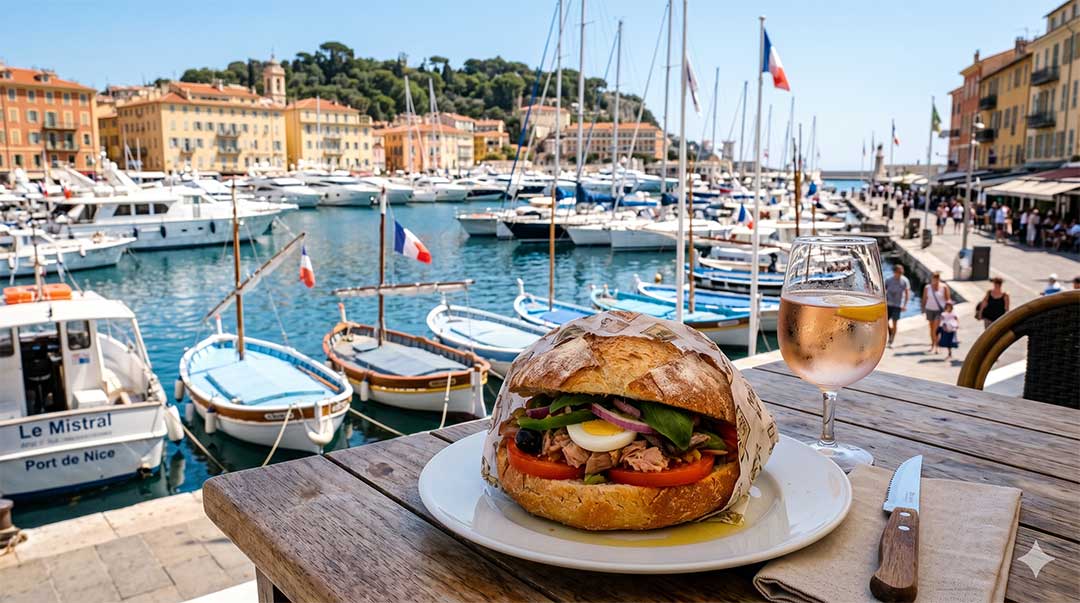
TL;DR: Pan bagnat is a Nicoise classic where bread is soaked in olive oil and packed with Nicoise salad ingredients, then pressed and rested overnight. Skipping the resting period produces a lesser result. The name means ‘bathed bread’ and that soaking process is the entire point.
The pan bagnat is not a sandwich in any sense that would satisfy a Pret a Manger. It is a transformation, and understanding that distinction changes everything about how you make it and why it matters.
Most people who encounter a pan bagnat for the first time describe it as a Nicoise salad inside a roll. That is technically accurate and almost entirely beside the point. The genius of the thing is not in its ingredients. It is in what happens to those ingredients when you compress them, seal them, and wait.
Pan bagnat translates loosely from Nicois dialect as ‘bathed bread.’ Not filled bread. Not stuffed bread. Bathed bread. The name is doing real work here, because it signals that the olive oil, the Tuna, the anchovies, the tomatoes and the olives are not merely sitting inside the bread. They are soaking into it, migrating through it, becoming part of it over time.
The sandwich, if you must call it that, originated in Nice as workers’ food. A round roll called a pain de campagne or a soft round bun was split, rubbed with garlic, drenched in olive oil, and packed with the same ingredients as salade Nicoise. The whole thing was then wrapped, weighted, and left to rest. That resting period is where the magic actually happens, and it is also the part most people skip when they try to replicate it at home.
Skipping it is, to be blunt, a mistake that produces a lesser object. What you get without the press and the rest is just a decent roll with salad in it. What you get with them is something categorically different.
When you press a pan bagnat, several things happen simultaneously. The bread compacts, losing some of its airiness and becoming denser and more cohesive. The tomatoes release their juice. The anchovies begin to dissolve slightly into the olive oil. The oil itself moves outward through capillary action, permeating the crumb of the bread from the inside out.
This is not just texture change. It is flavour redistribution on a structural level. After several hours, the bread no longer tastes like bread with tuna on it. It tastes like something unified, where every bite carries the same ratio of richness, acidity, salt, and fat. There are no dry patches, no undressed corners, no sudden mouthfuls of plain dough. The thing has been equalised by time.
Overnight pressing takes this further still. The anchovies almost disappear as a distinct element, but their presence deepens everything around them. The tomato acidity softens and rounds out. The olive oil loses its rawness and integrates. What starts as a collection of ingredients ends as a coherent flavour system. That is not something you can replicate in twenty minutes, no matter how good your components are.
In Nice, there is genuine civic pride attached to the pan bagnat, and the local syndicat d’initiative has at various points attempted to codify what is and is not permissible in the filling. Tuna is canonical. Anchovies, hard-boiled eggs, tomatoes, olives (black, preferably from the region), raw broad beans or artichoke hearts when in season, and plenty of olive oil – these are the accepted building blocks. What is explicitly forbidden, and this is stated with the kind of conviction usually reserved for constitutional matters, is cooked vegetables of any kind. No green beans in the Nicoise sandwich, even though they appear in the salad version that inspired it.
That stricture is not arbitrary. Cooked vegetables soften under pressing and can turn the interior of the pan bagnat into something unpleasantly mushy. Raw vegetables hold their structure better, contributing texture throughout the soaking process rather than dissolving into it. The rule exists because someone, at some point, learned this the hard way and decided to save future generations the trouble.
There is also the question of the bread itself. It needs to be robust enough to absorb oil without collapsing entirely, but open-crumbed enough to actually absorb it. A baguette is too narrow and too crusty. Sliced sandwich bread is too soft and lacks the structural integrity for overnight pressing. A round, slightly chewy roll sits in the right zone, and in Nice, the bread is specifically made for this purpose.
The process is simpler than the reverence surrounding it might suggest. What it demands is not skill so much as patience and a degree of forward planning.
There is a version of the pan bagnat that you can make and eat within the hour. People do this. They assemble the roll, drizzle some oil, and eat it fresh. It is perfectly fine. It is also not really a pan bagnat in any meaningful sense. It is a Nicoise salad roll, which is a different thing with a different result.
The honest pan bagnat requires that you make it the evening before you intend to eat it. This is not precious foodie gatekeeping. It is a practical observation that the dish only reaches its intended state after sufficient time has passed. Eating a fresh one is like eating cookie dough and claiming to have eaten a cookie. Technically related, fundamentally different.
The French Mediterranean sandwich tradition, particularly in Nice, has always understood food as something that exists in time rather than just in the moment of preparation. Confit, rillettes, slow-braised daubes, tapenade left to mellow – these are all preparations that improve through patience. The pan bagnat belongs to that same school of thought. It is a pressed sandwich from France that encodes a philosophy: that some things need to be left alone to become what they are meant to be.
You can, but the results are less consistent. Baguette crust is too hard and too uneven in thickness to absorb oil uniformly under pressing. The round roll provides a better surface area ratio and more even compression. If a round roll is genuinely unavailable, a ciabatta cut into individual portions works reasonably well as a substitute.
Technically yes, but you lose one of the key flavour agents that makes the overnight version taste as unified as it does. Anchovies dissolve and season the oil as it migrates through the bread, adding depth that is difficult to replicate. If you genuinely dislike anchovies, capers add some of the same brininess and acidity, though the result is noticeably lighter in character.
Wrapped tightly and refrigerated, a pan bagnat will keep reasonably well for around 24 hours after pressing. Beyond that, the bread begins to lose its structural integrity and the vegetables can become waterlogged. It is best made the evening before and eaten the following day. It was designed for portability and a specific window of consumption, not extended storage.
They share almost identical ingredients and a common origin in Nice, but they are different dishes with different experiences. Salade Nicoise is eaten immediately, assembled and dressed just before serving. Pan bagnat is built, compressed, and transformed over time. The relationship between them is something like the relationship between a freshly baked loaf and toast. Same raw materials, different outcomes.
The pan bagnat is ultimately a lesson in what restraint and time can do to simple ingredients. It rewards the person willing to plan ahead and penalises impatience with a noticeably inferior result. That is not a flaw in the dish. That is the point of it.

At Med.kitchen, our passion lies in crafting exceptional culinary experiences through our online platform. We specialise in sharing a wealth of knowledge via articles, recipes, courses, and online mentoring, aiming to inspire both novice and seasoned chefs alike. Our focus has shifted from private dining to being an online source of gastronomic inspiration, allowing you to explore and refine your culinary skills from the comfort of your home..