
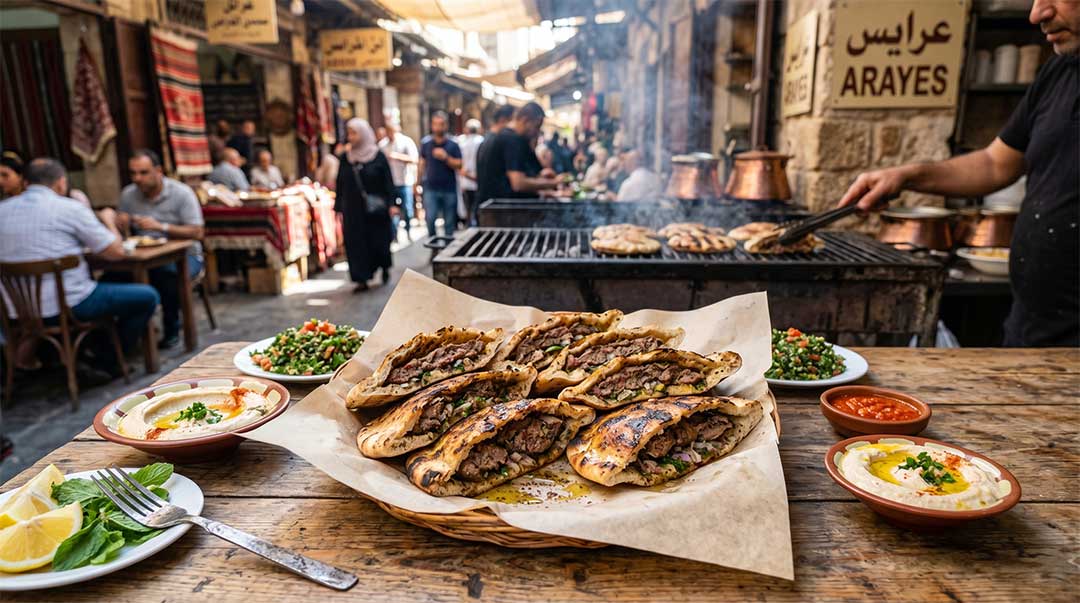
TL;DR: Arayes is flatbread stuffed with spiced minced meat and grilled until the fat renders into the dough itself, creating a charred, crisp, intensely savoury result. It is a staple across Lebanon, Palestine, and Syria and one of the most satisfying things you can cook over a flame.
Arayes is flatbread stuffed with spiced minced meat, then grilled until the fat renders into the bread itself, leaving the outside charred and crisp and the inside intensely savoury. It is one of the most satisfying things you can cook on a grill, and most people outside the Levant have never had it.
That is a genuine shame. Not a catastrophe, but a shame. Because arayes represents something interesting in the logic of cooking, a dish where the bread is not a wrapper or a vehicle. It is an active participant. It absorbs fat, takes on smoke, and ends up tasting like something entirely different from the sum of its parts.
The word ‘arayes’ (sometimes spelt ‘arais’ or ‘arays’) is Arabic for ‘brides’, a name that carries a kind of quiet elegance for something this rustic. The dish is found across Lebanon, Palestine, and Syria, with each region bringing its own interpretation of the spice mix and technique. At its core, the format is simple: take a round of flatbread, stuff it with raw spiced minced meat, press it together, and grill it over flame or on a griddle until everything caramelises.
The transformation that happens during cooking is what makes this worth talking about. The meat renders inside the bread. The fat has nowhere to go except into the dough itself. The edges char, and the surface becomes crisp in a way that a burger bun or a wrap could never achieve. This is the technical point that most people miss when they first encounter an array’s recipe.
The bread stops being passive. It becomes part of the cooking medium.
Lebanese versions tend to lean on a mixture of lamb or beef mince with onion, parsley, tomato, and a spice blend that usually includes allspice, cinnamon, and black pepper. Some cooks add a little chilli. The flavour profile is warm and aromatic rather than hot.
Palestinian preparations often use a similar base but may include sumac, which brings a citrussy sharpness that cuts through the richness of the fat. Syrian versions can incorporate pomegranate molasses in some households, adding a deep, slightly sour sweetness that works particularly well with fattier cuts of mince.
None of these versions is definitively ‘correct’. This is home cooking with roots in street food culture, and the recipe shifts with the family, the region, and what is in the kitchen. The common thread is the technique, not the exact spice list.
The following is a reliable starting point for a Lebanese-style version. It is not the only approach, but it works consistently and gives you a clear baseline to adjust from.
There is a broader principle embedded in Levantine street food that arayes illustrates particularly well: the idea that economy and flavour are not opposites. Minced meat is cheaper than whole cuts. Flatbread is inexpensive and widely available. But the technique transforms both into something that punches significantly above its cost.
This is what good street food cooking consistently does. It does not rely on premium ingredients. It relies on understanding what heat does to fat and how fat interacts with starch. The bread in arayes is essentially being deep-fried from the inside out. The meat acts as both filling and cooking fat simultaneously.
Most Western sandwich traditions keep the bread and the filling separate right up until eating. Arayes rejects that logic entirely. The cooking process fuses them. You cannot separate the bread from the meat after it is done. That is the point.
The most frequent error is using too much meat filling. A thick layer of mince will not cook through before the outside burns. Keep the filling layer thin and even, and the whole thing cooks quickly and consistently.
The second mistake is underheating the grill. Arayes needs real, direct heat to char properly. A low and slow approach produces something pale and slightly steamed, technically edible but missing the entire character of the dish. If you are using a griddle pan indoors, get it properly hot before the bread goes on.
Using very lean mince is also a mistake worth flagging. The fat content is what soaks into the bread. A 15 to 20 per cent fat content in your mince is not a problem here. It is the mechanism. Very lean meat will produce a drier result, and the bread will not take on the same richness.
Arayes sits in an interesting position in the hierarchy of grilled meat dishes. It is not as well known internationally as shawarma or kebabs, despite being arguably more accessible to cook at home. You do not need a vertical rotisserie. You do not need skewers. You need a grill, some mince, and flatbread.
Part of its relative obscurity in British food culture probably comes down to visibility. Lebanese restaurants here tend to focus on mezze and grilled meats rather than the more casual, street food end of the menu. Arayes lives in homes and in roadside grills in Beirut or Ramallah, not typically in the kind of restaurant setting that exports dishes to wider audiences.
That is shifting, slowly. More food writers and cooks are documenting Levantine home cooking in detail, and dishes like arayes are getting the attention they deserve. The stuffed flatbread format is also easy enough to adapt; some versions use cheese alongside the meat, and vegetarian interpretations with spiced lentils or halloumi exist, though they produce a different result and should probably be considered separate dishes.
Yes. A cast-iron griddle pan on a high heat works well indoors. You will get good char on the bread, though you will miss the smokiness that comes from charcoal. A contact grill (like a sandwich press) can also work in a pinch, though the result will be less charred and more toasted. It is worth pressing down firmly with a spatula during cooking regardless of the method.
Khobez, the thin Lebanese flatbread, is traditional and ideal. Standard supermarket pitta works perfectly well; the thinner, the better. Avoid thick flatbreads or naan-style bread, which are too dense for the filling to cook through consistently. You want something thin enough that the fat can migrate through the dough during grilling.
You can stuff the bread and refrigerate the assembled arayes for a few hours before cooking. Keep them covered so the bread does not dry out at the edges. Cooking from cold may require an extra minute or two on the grill. Assembled but uncooked arayes do not freeze particularly well, as the moisture from the raw meat affects the bread texture once defrosted.
Plain yoghurt or a simple garlic yoghurt sauce is the most common accompaniment. A chopped tomato and parsley salad works well alongside. Some versions are served with a basic tahini sauce, which complements the spiced meat nicely. The dish is rich enough that it does not need much on the side; a little acidity to balance the fat is the main thing to aim for.
Arayes rewards the person who makes it once and then immediately wants to make it again. The technique is simple, the ingredients are affordable, and the result is far greater than either of those things suggests. If you have been treating flatbread as something that simply holds other food together, this dish will make you reconsider that assumption. Bread can be a cooking surface. It can be a fat-absorbing crust. It can be the reason the whole dish works. That is worth more thought than most sandwich logic ever gives it.

At Med.kitchen, our passion lies in crafting exceptional culinary experiences through our online platform. We specialise in sharing a wealth of knowledge via articles, recipes, courses, and online mentoring, aiming to inspire both novice and seasoned chefs alike. Our focus has shifted from private dining to being an online source of gastronomic inspiration, allowing you to explore and refine your culinary skills from the comfort of your home..