
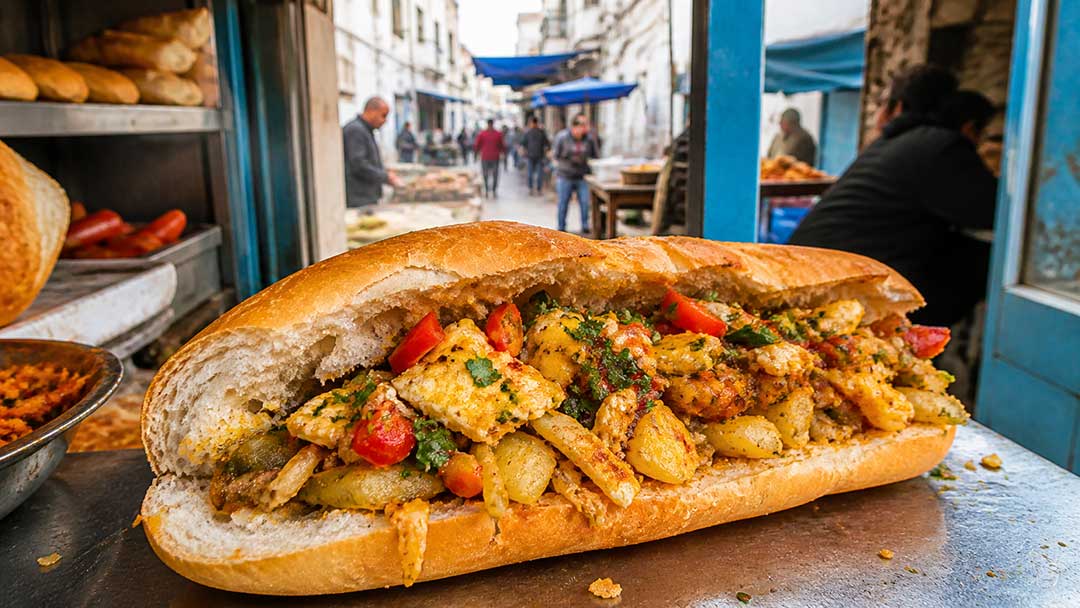
TL;DR: Kefteji Tunisia is a hearty street food sandwich packed with fried courgette, potato, peppers, egg, and harissa in a crusty baguette. It is bold, oily, and magnificent, a dish that shows how North Africa made French colonial bread entirely its own.
Kefteji Tunisia is one of those street foods that makes you question every sandwich you have eaten before it. Fried courgette, fried potato, fried peppers, a whole fried egg, harissa, and sometimes merguez, all crammed into a crusty baguette with total disregard for structural integrity. It is not subtle. It is not trying to be.
Kefteji is a Tunisian street food sandwich built almost entirely from things cooked in hot oil. The name likely derives from the Turkish ‘köfte’, pointing to the Ottoman presence in the Maghreb, though in its current form the dish belongs completely to Tunisia. You will find it sold from small stalls and hole-in-the-wall shops, usually in the morning or at lunchtime, wrapped in paper and eaten standing up.
The filling varies slightly by region and by vendor, but the core is consistent: seasonal vegetables, typically courgette, potato, and green pepper, fried until soft and a little caramelised at the edges. An egg gets fried alongside them, often broken into the pan and cooked until the edges crisp. Harissa goes in. The whole lot is folded into a baguette, and that is your lunch.
What makes it interesting is the texture. Everything is yielding except the bread, which provides just enough resistance. The harissa brings heat that builds slowly rather than hitting immediately. If there is merguez in there as well, the spiced fat from the sausage bleeds into the bread, and the whole thing becomes something genuinely difficult to put down.
The baguette is not native to Tunisia. France colonised Tunisia from 1881 until independence in 1956, and one of the things it left behind was a bread culture. The baguette took root in the Maghreb in a way it perhaps did not even in France, where it faces competition from a wider range of bread forms. In Tunisia, Morocco, and Algeria, the baguette became everyday food, bakery staple, and the default vessel for street food.
This is the thing about culinary colonialism that tends to get glossed over: the colonised do not simply receive and preserve. They take what is useful and rebuild it entirely around their own ingredients and habits. The Tunisian baguette is softer than the Parisian version, slightly different in crust, better suited to being stuffed aggressively. The North African sandwich tradition that grew around it has no real French analogue. A jambon-beurre this is not.
Kefteji is one expression of that transformation. The bread is French in origin. Everything inside it is North African in flavour, technique, and spirit. The combination belongs to no one except the people who make and eat it.
You cannot talk about a harissa baguette without spending a moment on harissa itself. The paste, made from dried chillies, garlic, caraway, coriander, and olive oil, is not a condiment in the way that ketchup is a condiment. It is not optional, not a finishing flourish. In Tunisian cooking it is structural. Food is often built around it rather than decorated with it.
Tunisian harissa is sharper and more aromatic than the versions now widely available in Western supermarkets. The caraway in particular gives it a slightly bitter, earthy note that cuts through the richness of the fried vegetables. In a kefteji, it does the work that acid might do in another cuisine: it lifts and sharpens everything around it.
UNESCO added Tunisian harissa to its Intangible Cultural Heritage list in 2022, which generated some predictable commentary about whether a chilli paste really needs international recognition. I think the question misses the point. The recognition is not about the paste in isolation. It is about the knowledge of how to make it, the seasonal rhythms of chilli drying, the family recipes passed without being written down. That is worth acknowledging.
Tunisian street food is not a tourist attraction. It is what people actually eat. The distinction matters because it shapes everything: price, portion size, speed of service, the absence of any attempt to make things visually presentable for a camera. Kefteji is not arranged. It is assembled under pressure for someone who needs to eat before getting back to work.
This functional quality is part of what makes it worth paying attention to. The dish exists because it solves a real problem: it is filling, it is cheap, it uses vegetables that are available, and it can be made quickly in a single pan over high heat. The fried egg is not garnish. It is protein. The baguette is not artisanal. It is a container.
There is a version of food writing that romanticises poverty food, projecting onto it a kind of earthy wisdom that its makers would find baffling. Kefteji does not need that treatment. It is straightforwardly good and straightforwardly practical, and those two things are not in tension with each other.
If you want to attempt kefteji at home, the technique is more important than the ingredient list. You need a pan that gets genuinely hot. The vegetables should be cooked in batches if necessary so they fry rather than steam. Courgette sliced into rounds, potato cut thin enough to cook through quickly, green pepper in strips. Each goes into the oil separately and comes out when it has some colour on it.
The egg goes in last. Break it into the pan and let it cook until the white is set and the edges are crisp, but leave the yolk soft. When you build the sandwich, the yolk will break and coat everything else. This is not an accident. It is the point.
Harissa quantity is a personal decision, but ‘more than you think’ is a reasonable default if you are used to Western chilli tolerances. The bread should be fresh and slightly warm. A baguette from a good bakery works well. A supermarket one will do in a crisis, though the texture is noticeably softer and the whole thing becomes slightly more precarious to eat.
The baguette in North Africa is a genuinely interesting object. It arrived as a colonial import and has become, in the space of a few generations, a local staple with its own regional character. The people eating kefteji on a street corner in Tunis are not thinking about French colonialism. They are eating lunch. But the history is there in the bread, and it is not a simple story of imposition or of loss.
Food absorbs its history and then moves on. The ingredients of kefteji come from different points on a long, complicated map: chillies from the Americas via the Ottoman spice trade, bread technique from France, vegetables grown in North African soil, a name with Turkish roots. None of that complexity is legible in the sandwich itself. You just taste the result.
What does it mean when a colonised culture takes the bread of its coloniser and stuffs it full of something the coloniser would barely recognise? It probably means something different depending on who you ask. What seems clear is that the outcome, this specific, unapologetic, fried everything sandwich, belongs entirely to Tunisia now. Whatever the origin of its components, nothing about kefteji reads as borrowed.

At Med.kitchen, our passion lies in crafting exceptional culinary experiences through our online platform. We specialise in sharing a wealth of knowledge via articles, recipes, courses, and online mentoring, aiming to inspire both novice and seasoned chefs alike. Our focus has shifted from private dining to being an online source of gastronomic inspiration, allowing you to explore and refine your culinary skills from the comfort of your home..