
TL;DR: Sabich is an Iraqi-Jewish sandwich of fried aubergine, hard-boiled egg, amba, and tahini in pita. It began as a Shabbat morning meal in Iraq and became an Israeli street food staple after mass Jewish emigration in the late 1940s.
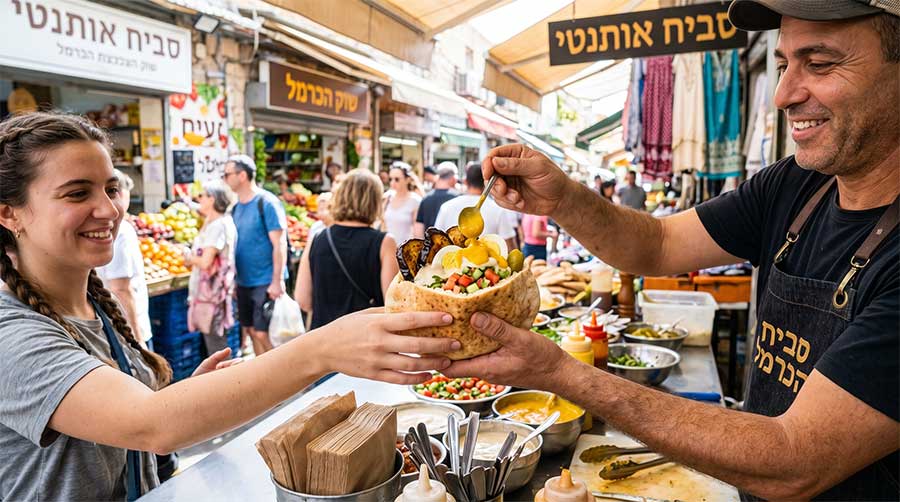
Sabich is an Iraqi-Jewish sandwich built from fried aubergine, hard-boiled egg, amba, tahini, and Israeli salad, all stuffed into a soft pita. It arrived in Israel with Jewish immigrants from Iraq and quietly became one of the country’s most beloved street foods. What that journey tells us about migration, identity, and culinary transformation is far more interesting than the sandwich itself.
Well. Almost.
The word ‘sabich’ is believed to derive from the Arabic word for ‘morning,’ which makes sense once you understand its origins. In Iraq, Jewish families would eat a Shabbat morning meal built around fried aubergine and hard-boiled eggs. These were foods that could be prepared the evening before, requiring no cooking on the Sabbath itself. Practical, deeply traditional, and tied to religious observance.
When Iraqi Jews began emigrating to Israel in large numbers during the late 1940s and early 1950s, they brought this meal with them. The sandwich format came later. Credit is often given to Sabich Halabi, a man who reportedly began selling the filling stuffed into pita from a stall in Ramat Gan during the 1960s. Whether the sandwich is literally named after him or whether his name matched the dish by coincidence remains debated. Either way, the street food version of sabich was born from that encounter between a private domestic ritual and a public commercial context.
This is how diaspora food tends to work. A home practice gets adapted to a new environment, simplified for speed and portability, and gradually accepted by people who had no connection to its original context. What starts as ‘Iraqi Jewish food’ becomes Israeli food. The seams are still visible if you know where to look.
The core components are worth examining individually, because each one carries its own history. The fried aubergine is the heart of the sandwich. Sliced, salted, and fried until deeply golden, it has a richness and density that holds up against the other ingredients without becoming lost. Aubergine is a staple across the Levant and Middle East, but this particular treatment, fried rather than roasted or grilled, gives sabich its distinctive texture.
The hard-boiled egg is the second defining element. In the original Shabbat meal, it would have been slow-cooked overnight alongside the aubergine. In a street food context, it is simply hard-boiled, sliced, and layered into the pita. It adds a quiet, almost neutral richness that balances the stronger flavours around it.
Then there is amba. This is the ingredient that confuses most people who encounter sabich for the first time. Amba is a fermented mango pickle sauce, tangy and pungent, with a flavour profile unlike anything in the European or American culinary vocabulary. It was brought to Iraq by Indian Jewish traders in the 19th century, which makes it a twice-migrated ingredient, moving from India to Iraq to Israel. Its presence in sabich is a small lesson in how complex culinary genealogies really are.
Tahini, Israeli salad (finely diced tomato and cucumber), and often a boiled potato and zhug (a fiery Yemeni herb sauce) complete the picture. The finished sandwich is loud with flavour. Creamy, acidic, smoky, fatty, fresh. Everything happening at once, and somehow coherent.
Sabich sits alongside falafel and shawarma as one of the defining dishes of Israeli street food. But unlike falafel, which has a longer and more contested claim to Israeli identity, sabich has a relatively clear and documented origin story. It came from a specific community, in a specific decade, through a specific set of circumstances. That clarity is unusual in food history, and worth appreciating.
The question of who ‘owns’ a dish is always complicated, and nowhere more so than in Israel and the broader Middle East. Food here carries political weight that food in other contexts simply does not. Claiming a dish as national tends to erase the minority communities that created it. In the case of sabich, the Iraqi Jewish origin is well-documented and broadly acknowledged. The sandwich has not been stripped of its roots in the way that other dishes sometimes are.
That acknowledgement matters. It allows the food to serve as a visible reminder that Israeli cuisine, like all cuisines, is assembled from waves of migration and exchange. The Yemeni Jews brought zhug. The Moroccan Jews brought spiced meats and preserved lemons. The Eastern European Ashkenazi Jews brought entirely different traditions. The Arab Palestinian population had its own food culture that pre-dated the state entirely. None of this resolves the political complexities, but it does illustrate that a cuisine is never a fixed, singular thing.
What makes sabich particularly interesting as a case study is how little it changed during its adaptation. Many dishes that travel across cultures get softened, adjusted for local tastes, or simplified to the point of losing their character. Sabich resisted this. The amba stayed pungent. The aubergine stayed fried rather than being swapped for something less challenging. The egg stayed in.
This stubbornness is partly what allowed sabich to eventually become mainstream rather than remaining a niche community food. Israelis who encountered it were not given a diluted version. They were given the real thing, and they came to love it on its own terms. That is a rarer outcome than it sounds.
Compare this to how hummus or falafel are often treated when they travel to Western Europe or North America. The flavours get toned down, the textures get adjusted, the context gets stripped away. What arrives is a shadow of the original. Sabich, largely because it developed its street food form within Israel rather than in export markets, avoided this fate.
There is a tendency to romanticise migrant food. The narrative of the grandmother’s recipe preserved across generations, unchanged and sacred, is comforting but usually inaccurate. Food adapts because people adapt. Ingredients become unavailable. Equipment changes. Time pressures shift. New flavours enter the vocabulary. The miracle is not that food stays the same. The miracle is that it carries enough of its original identity to still mean something.
Sabich carries the shape of Shabbat morning. It carries the Iraqi Jewish experience of keeping religious observance alive under Ottoman and then British rule, and then navigating the mass emigration of the late 1940s. It carries a trade route through India via amba. All of this is present in the sandwich, not in any mystical sense, but in the very practical sense that the ingredients and techniques were chosen by people whose lives contained all of that history.
When you eat sabich standing at a stall in Tel Aviv, you are eating something assembled in about ninety seconds by someone who may or may not know any of this. That gap between the depth of a food’s history and the casualness of its consumption is not a problem. It is just how culture works.
Falafel made it to every high street in the Western world. Shawarma followed. Sabich has been slower to travel, and the reason is probably amba. The fermented mango sauce is an acquired taste with a smell that stops some people before they even try it. Street food that requires acquiring a taste tends to spread more slowly than food that delivers immediate, uncomplicated pleasure.
But that is precisely what makes it interesting. Sabich does not negotiate. It presents itself fully formed and asks you to meet it where it is. For anyone serious about understanding the breadth of Levantine and Middle Eastern food culture, it is essential. Not as an exotic novelty, but as a genuinely distinct and deeply considered piece of culinary thinking that happens to come in a pita.
The Iraqi Jewish community that brought sabich to Israel was largely absorbed into the general population within two or three generations. The sandwich outlasted the community’s distinctiveness. That is both a small sadness and a remarkable form of cultural continuity. The food remembered what the broader society moved past.

At Med.kitchen, our passion lies in crafting exceptional culinary experiences through our online platform. We specialise in sharing a wealth of knowledge via articles, recipes, courses, and online mentoring, aiming to inspire both novice and seasoned chefs alike. Our focus has shifted from private dining to being an online source of gastronomic inspiration, allowing you to explore and refine your culinary skills from the comfort of your home..