
TL;DR: Ekmek arasi means ‘between bread’ and covers any hot filling stuffed into a fresh roll with minimal fuss. Turkish street food culture resists artisanal theatre, and that is precisely why it works. Simplicity and heat do more than curation ever could.
Turkish street food does not need rescuing. That is probably the most important thing to understand before you try to make sense of it.
There is a global tendency, particularly visible in cities with money and ambition, to ‘elevate’ street food. To give it a backstory, a tasting note, a provenance card. To serve it on reclaimed wood with a side of context. Istanbul has largely ignored this tendency, and the city is better for it. The ekmek arasi – literally ‘between bread’ – sits at the centre of that resistance. It is a category as much as a dish: anything stuffed into a bread roll and handed over a counter with the confidence of someone who has done it ten thousand times before.
Ekmek arasi translates directly as ‘between bread’, and in practice it covers an enormous range of fillings, breads, and settings. It is not a specific recipe. Think of it less as a dish and more as a philosophy: hot filling, fresh bread, minimal fuss. The ekmek itself is usually a white roll with a soft crumb and a crust that offers just enough resistance without making a mess of your shirt.
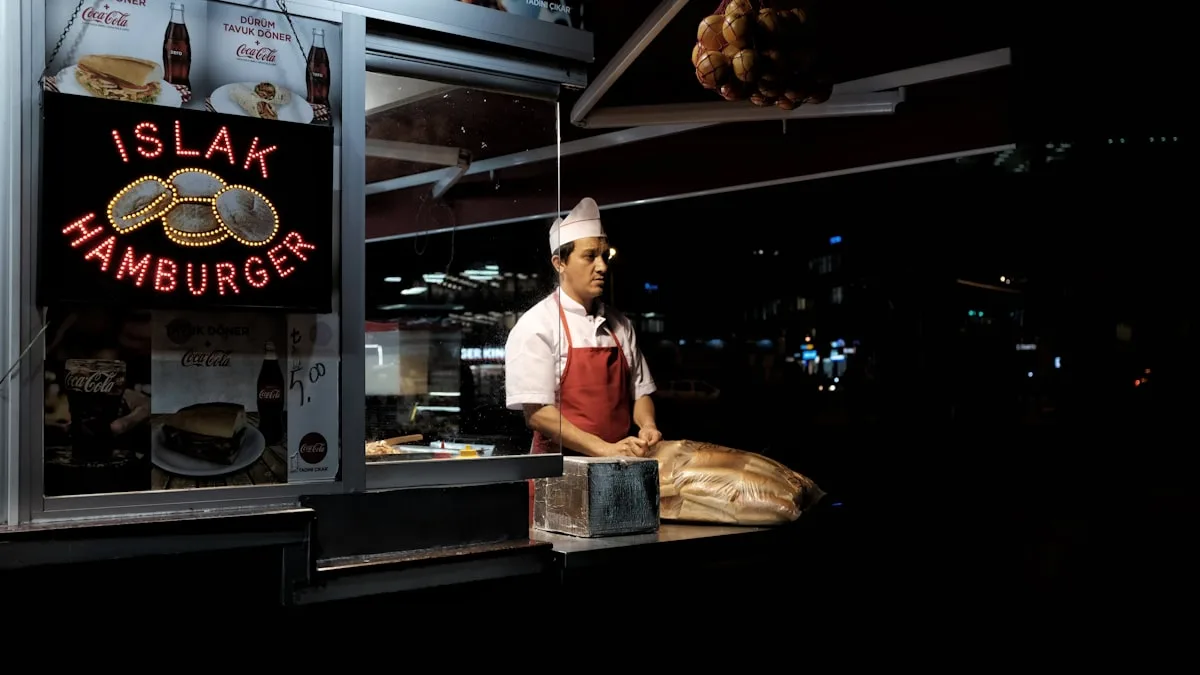
What distinguishes the Turkish approach from the artisanal sandwich culture that has consumed so much of Europe and North America is a studied indifference to theatre. The person making your sandwich is not performing. They are working. The distinction matters more than it sounds.
If there is one Turkish street food sandwich that has crossed over into genuine international recognition, it is the balik ekmek. Grilled mackerel, usually cooked on the spot over charcoal or gas on a rocking boat moored near the Galata Bridge, slid into a half-loaf of white bread with raw onion, lettuce, and a squeeze of lemon. That is it. No aioli. No house-made pickle brine. No laminated menu.
The balik ekmek Istanbul experience is inseparable from its context. The Bosphorus fish roll is consumed standing up, usually with a plastic cup of sour cherry juice or ayran nearby, within earshot of seagulls and ferry horns. The mackerel is oily and smoky. The bread absorbs the juices. The onion cuts through the fat. Every element is doing a job, and no element is showing off.
There have been periodic attempts by Istanbul’s municipality to formalise and restrict the balik ekmek trade, largely on food safety grounds. These attempts have been met with public outcry each time, which tells you something about how embedded this particular sandwich is in the city’s self-image. It is not nostalgia, exactly. It is more like civic ownership. The balik ekmek belongs to the waterfront the way the ferry does.
If balik ekmek is Istanbul’s daytime sandwich, kokorec is its nocturnal counterpart. lamb intestines, seasoned with oregano, cumin, and red pepper, wrapped around offal and slow-cooked on a rotating spit, then chopped finely and piled into bread. It sounds confrontational if you describe it clinically. In practice, it smells extraordinary from thirty metres away and tastes like the kind of thing you would happily eat twice in one night.
Kokorec carts appear after midnight, positioned near clubs, meyhanes, and anywhere else that generates the kind of hunger that bypasses rational decision-making. The cooking method is important: the long rotation on the spit renders the fat slowly, and the final chopping on the griddle creates a texture that is simultaneously crispy and yielding. Heat is doing most of the flavour work here. Seasoning is present but restrained.
Like balik ekmek, kokorec has faced regulatory pressure. The EU accession process brought EU food standards into consideration, and intestines from ruminants became a point of contention. Turkey has held its ground. The political argument about kokorec has always been, at its core, a cultural argument about whether external frameworks should determine what a city eats at two in the morning.
One of the things that unites Turkish street sandwiches is an almost aggressive reliance on heat as a transformative tool. The mackerel is grilled. The kokorec is rotisserie-cooked and then griddled again. Even the humble sucuklu ekmek – spiced beef sausage in bread – depends entirely on the sizzle of a dry pan to bring out the fat and spice in the sucuk. Cooking is not decoration here. It is the primary event.
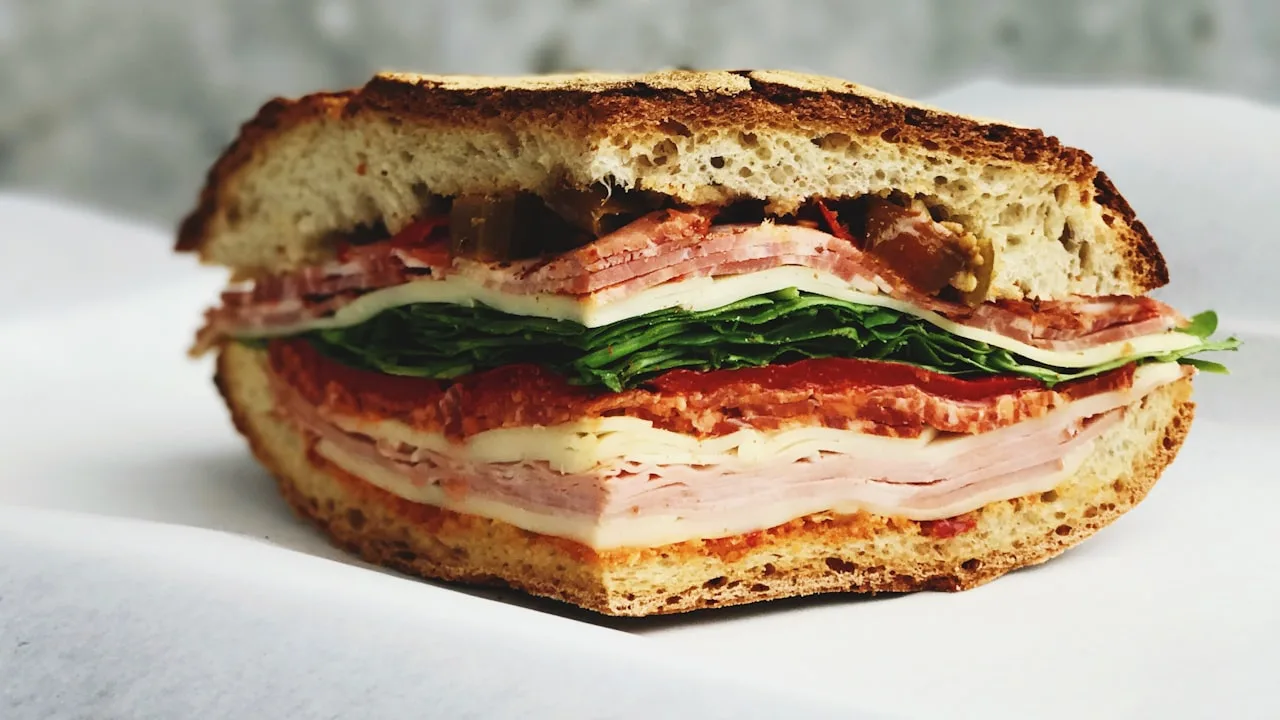
This stands in contrast to the trend in contemporary sandwich culture, which often privileges assembly over cooking. The cold-cut charcuterie board dropped into a ciabatta. The carefully layered club sandwich with its architectural ambitions. Turkish street food, broadly speaking, is not interested in architecture. It is interested in temperature, fat, and timing.
Simplicity, in this context, is not poverty of imagination. It is restraint born of long practice. The vendors who have been grilling mackerel at Eminonu for twenty years are not unaware that they could add more ingredients. They have simply learned that more ingredients would make the sandwich worse.
The artisanal turn in street food, which accelerated sharply through the 2010s, rested on a seductive premise: that street food becomes better when it becomes more self-aware. When it knows its own history, sources its ingredients with intention, and presents itself with a degree of aesthetic coherence. There is something to this. But it also introduced a set of values that were never native to street food in the first place.
Street food works because it is efficient, affordable, and calibrated to hunger rather than aspiration. The moment it starts calibrating to aspiration, it stops being street food and becomes something else, something that might be perfectly enjoyable but is doing a different job. Istanbul’s sandwich culture has not made that trade. Whether through cultural stubbornness or simple commercial wisdom, it has remained calibrated to hunger.
This is not an argument against quality. The best balik ekmek vendors are fastidious about their fish and their bread. It is an argument against curation as an end in itself. There is a difference between quality and performance. Turkish street food, at its best, is entirely the former.
The balik ekmek and kokorec get most of the international attention, but the ekmek arasi tradition runs considerably wider than those two examples.
Each of these shares the same underlying logic: a hot filling, a receptive bread, and a transaction that takes about forty-five seconds from request to hand-off. Speed is not incidental. Speed is part of the value proposition.
Ekmek arasi translates from Turkish as ‘between bread’. It refers broadly to any filling served inside a bread roll or loaf, and functions more as a category than a specific dish. The term covers everything from grilled fish to spiced offal to simple grilled cheese.
The most well-known balik ekmek vendors are moored on the boats near Eminonu and the Galata Bridge on the European side of the city. The quality is fairly consistent across the boats, and the setting – with the Bosphorus directly behind you and the New Mosque ahead – is genuinely part of the experience. Arrive hungry and eat it immediately.
Kokorec is cooked through thoroughly via the rotisserie process, and reputable vendors rotate their stock regularly. As with any street food, busier stalls with high turnover are a reasonable indicator of freshness. It has been eaten safely in Istanbul for generations. The EU-era anxieties about it were largely regulatory rather than epidemiological.
There is no single explanation, but a combination of factors seems likely. Strong cultural attachment to specific foods and their preparation methods, an economy where affordability remains central to the street food value proposition, and a general preference for continuity over novelty in the vendor community. Istanbul has also always been a working city with a pragmatic relationship to food.
The deeper question, and one worth sitting with, is whether the artisanal sandwich movement was ever really about the food at all. Istanbul’s ekmek arasi culture suggests that the best sandwiches are the ones made by people who have stopped thinking about them. Who know, without deliberation, exactly how much heat the fish needs and precisely how much onion is too much. That kind of knowledge is not curated. It is accumulated. And no amount of provenance labelling gets you there faster.

At Med.kitchen, our passion lies in crafting exceptional culinary experiences through our online platform. We specialise in sharing a wealth of knowledge via articles, recipes, courses, and online mentoring, aiming to inspire both novice and seasoned chefs alike. Our focus has shifted from private dining to being an online source of gastronomic inspiration, allowing you to explore and refine your culinary skills from the comfort of your home..