
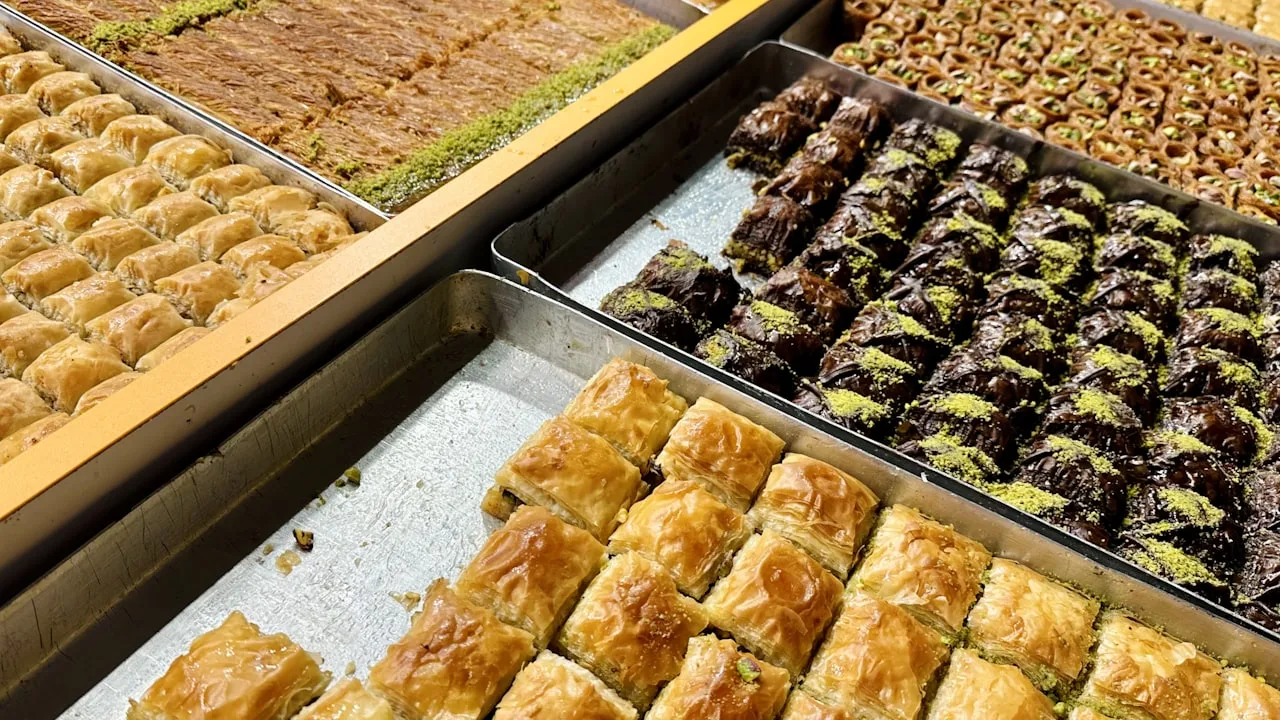
Baklava belongs to everyone and no one, which is precisely why the argument over its origins has lasted longer than most empires. Ask a Greek grandmother, a Turkish pastry chef, and a Lebanese confectioner the same question and you will receive three entirely different answers, each delivered with complete conviction.
Food origin arguments are rarely just about food. They are about identity, pride, and the uncomfortable truth that history rarely respects modern borders. Baklava is a particularly charged case because it sits at the intersection of three civilisations that shaped the Mediterranean world, and because it is genuinely, stubbornly delicious. That combination makes objectivity difficult.
Before getting into the competing claims, it helps to be precise about the thing itself. Baklava, in its most widely recognised form, is a layered pastry made from thin sheets of filo dough, filled with chopped nuts, bound together with clarified butter, and soaked after baking in a sugar syrup or honey. The result is something simultaneously crisp and yielding, floral and rich, with a sweetness that lingers without becoming cloying when made properly.
The word “filo” comes from the Greek for leaf, though the technique of stretching dough to near-translucent thinness likely predates Greek usage of the term. This is already a clue that unpicking ownership is going to be complicated. The pastry crosses linguistic, culinary, and political lines almost by design.
The strongest institutional claim belongs to the Ottoman Empire. The earliest documented recipe resembling modern baklava appears in the Topkapi Palace kitchens during the fifteenth century, and the palace had an entire kitchen brigade dedicated to sweet pastries. Ottoman records from the reign of Suleiman the Magnificent describe layered pastry dishes being prepared for Janissary soldiers during Ramadan, a practice that became ritualised over centuries.
The Ottoman case is essentially a state-sponsored one. The empire absorbed, standardised, and redistributed an enormous range of culinary traditions across its territories, from the Balkans to the Arabian Peninsula. Baklava as we recognise it today, uniform in technique and widely reproduced across former Ottoman lands, is genuinely a product of that imperial kitchen culture.
Turkish baklava, particularly the version from Gaziantep, carries a protected geographical indication from the European Union, granted in 2013. That is a modern political act, not a historical verdict, but it illustrates how seriously the claim is taken at an institutional level. Gaziantep baklava uses a specific local pistachio and a particular layering technique that is considered distinct even within Turkey itself.
Greece’s claim rests on older culinary lineage. Ancient Greek texts reference a dish called “gastris,” a layered confection made with nuts and honey, and there are references in the works of Athenaeus, writing around the second century AD, to layered nut pastries being served at banquets. The Greeks argue, reasonably, that the conceptual architecture of baklava, layered dough, nuts, and sweetener, existed in the Hellenic world long before the Ottomans arrived.
Greek baklava tends to use honey rather than sugar syrup, which its proponents argue is the older and more authentic preparation. The distinction matters symbolically even if, to most palates, the practical difference is subtle. Honey connects the dish to antiquity; refined sugar connects it to the post-medieval trade networks that Ottoman and Arab merchants both helped establish.
There is also a cultural continuity argument. Greek communities throughout the former Ottoman territories maintained their own versions of baklava across centuries of political change. The dish did not disappear with Byzantine authority; it persisted, adapted, and was passed between households in ways that formal imperial records never quite capture.
Arab culinary historians point to mediaeval Arabic cookbooks, particularly those from the Abbasid period, which describe layered pastries soaked in sweet syrups. A thirteenth-century Baghdad cookbook, the Kitab al-Tabikh, contains recipes with structural similarities to baklava. The Abbasid Caliphate was the intellectual and culinary centre of the mediaeval Islamic world, and its influence on Ottoman court cuisine was considerable and well-documented.
Persian influence adds another layer, almost literally. The Sassanid Empire had its own tradition of layered pastry and sweet confections, and Persian culinary influence flowed into both the Arab world and, later, into the Ottoman court through the movement of scholars, cooks, and merchants. The word “baklava” itself may derive from a Mongolian or Turkic root, which neatly complicates the Persian claim without resolving anything.
Lebanese, Syrian, and Palestinian versions of baklava use rose water and orange blossom water more prominently than Turkish versions, and favour different nut combinations. These are not minor variations. They reflect genuinely distinct culinary traditions that developed in parallel rather than descending from a single Ottoman source.
The honest answer is that baklava as a single unified dish probably never existed in the way the ownership debate implies. What we call baklava is a family of related pastries that share technique and ingredients but evolved across multiple cultures simultaneously. Claiming one civilisation invented it is a bit like arguing about who invented bread.
The Ottoman Empire did not create baklava from nothing; it inherited, refined, and institutionalised a tradition that already existed across its conquered territories. The Greeks did not invent filo pastry in isolation; they were part of a wider Mediterranean and Middle Eastern culinary exchange. Arab and Persian cooks contributed methods and flavour profiles that shaped the dish before the Ottoman state even existed.
Food historians generally acknowledge what politicians and grandmothers are reluctant to admit: culinary origin is almost always diffuse. Dishes evolve through trade, migration, conquest, and simple neighbourliness. Assigning a single national owner to baklava requires ignoring the very history that made it worth arguing over.
When Greece and Turkey have diplomatic tensions, baklava becomes a proxy. When Lebanese and Israeli chefs clash over hummus or falafel on social media, the same territorial instinct applies to pastry. These arguments are not really culinary disputes; they are identity disputes wearing a sugary disguise.
There is something poignant about that. The fact that multiple peoples claim baklava with such fierce affection is itself a kind of testimony to the dish’s quality. Nobody fights over mediocre food. The intensity of the argument is proportional to the pleasure the thing gives, and on that score at least, all sides can agree.
The more productive question is not who owns baklava but what its disputed history reveals about the region that produced it. The Mediterranean and Near East were never a collection of sealed national kitchens. They were a continuous, messy, generative exchange of people, goods, and techniques across centuries. Baklava is one of the more delicious outcomes of that process.
Perhaps the more interesting question, once you have accepted that no single nation gets the trophy, is what it means that so many different peoples feel that baklava is unmistakably theirs. That kind of parallel ownership, each tradition finding something essential and personal in the same pastry, might be the most honest thing the argument has ever produced.

At Med.kitchen, our passion lies in crafting exceptional culinary experiences through our online platform. We specialise in sharing a wealth of knowledge via articles, recipes, courses, and online mentoring, aiming to inspire both novice and seasoned chefs alike. Our focus has shifted from private dining to being an online source of gastronomic inspiration, allowing you to explore and refine your culinary skills from the comfort of your home..