
TL;DR: The tramezzino is a crustless, triangular Italian sandwich invented in Turin in 1925. Named by poet Gabriele D’Annunzio, it spread through Italian bars and developed strong regional identities. Simple in form, it carries genuine cultural and culinary significance.
The tramezzino is a crustless, triangular sandwich that has quietly accumulated more cultural significance than most foods three times its size. It is modest in appearance, genuinely interesting in history, and far more contested in its regional variations than you might expect from something that is, at its core, bread and filling.
Turin, 1925. The Caffè Mulassano, a small and rather beautiful art nouveau bar near the Piazza Castello, is generally credited with inventing the tramezzino. The owners, returning from travels that included time in England, brought back the idea of thin, crustless sandwiches made with soft white bread. What they produced was something that fitted neatly into the Italian bar ritual: quick, portable, satisfying, eaten standing up with a coffee or a small glass of something cold.
The name itself was coined by the poet and writer Gabriele D’Annunzio, who reportedly suggested ‘tramezzino’ as a replacement for the Anglicism ‘sandwich.’ The prefix ‘tra’ means between, so the word roughly translates as ‘something in between’, which is both a description and, unintentionally, a fairly apt summary of where the thing sits culturally. Not a full meal. Not a snack exactly. Something in between.
D’Annunzio’s involvement is worth pausing on, not because poets typically shape food culture, but because it tells you something about how seriously Italians take the language of their food. This was the era of Italian linguistic nationalism, and borrowing the word ‘sandwich’ from the English felt like a small surrender. The tramezzino, as a name, was a way of owning the thing properly.
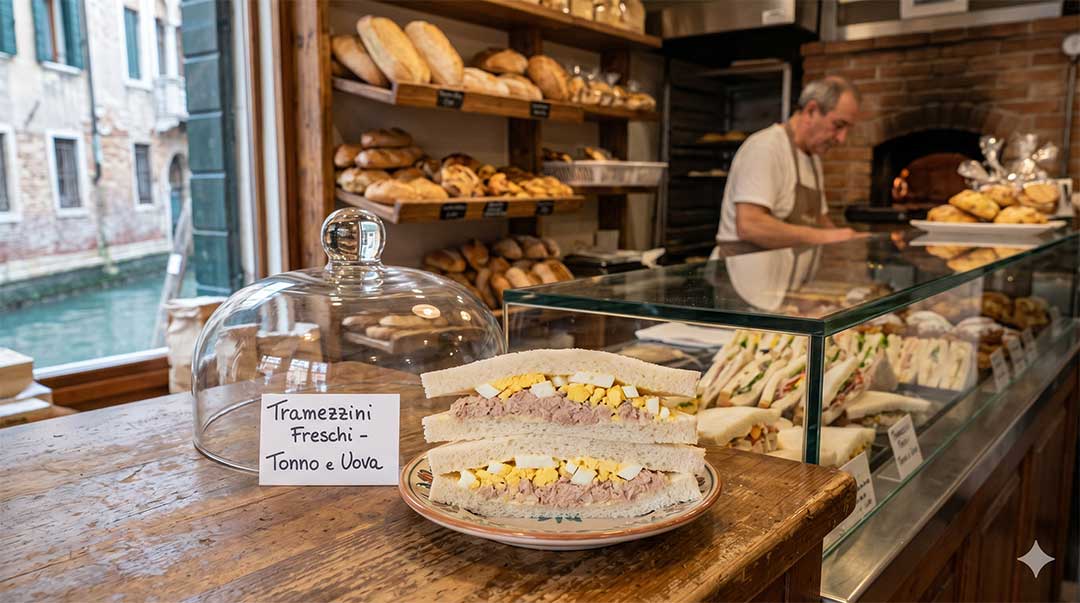
Turin may have invented it, but Venice is where the tramezzino truly found its cultural home. Walk into any traditional bar in Venice, the kind that has been serving the same clientele since the 1970s, and you will find a glass counter displaying tramezzini in stacked, generous rows. They are bigger than you expect. The fillings are layered with a confidence that borders on ambition.
Venetian tramezzini are notably different from what you find elsewhere. The bread is softer, often slightly damp at the edges from contact with the fillings, which are themselves more elaborate. Tuna and olive, prawn and artichoke, egg and anchovy, bresaola and rocket with a slick of mayonnaise. The mayonnaise question is significant: in Venice, mayonnaise is not an afterthought. It is practically structural.
The bars that serve them, called bacari in Venice, operate within a distinct social ritual. The tramezzino is consumed alongside a small glass of wine, typically a white Veneto variety, in a practice known as ‘ombra.’ The word means ‘shade,’ and the ritual of having a quick drink and a bite in a bar has its own tempo and etiquette. The tramezzino slots into this perfectly because it is not fussy, does not require a plate in most cases, and disappears in three or four bites.
This sounds like a simple question. It is not. The bread is the starting point and the most contentious element. It must be very soft white bread, often called ‘pane tramezzino,’ which comes in large rectangular loaves. The crust is removed. The bread should have some structural integrity but yield immediately when you bite into it. If it is too airy, the filling compresses the whole thing into a dense, unsatisfying wedge.
The filling ratio matters enormously. Too little and you are eating sweetened air. Too much and the whole construction collapses before it reaches your mouth. Italian bars that have been doing this well for decades operate with an almost unconscious precision on this front, the experienced person behind the counter knows the right amount by feel.
Temperature is underrated. A tramezzino served slightly cool, not cold, not room temperature, but the temperature of a bar that has air conditioning doing a moderate job, is noticeably better than one that has been sitting in direct light. The fillings stay firmer. The bread holds its texture. These are small things that compound into a meaningfully better experience.
Beyond Venice and Turin, the tramezzino has dispersed across Italy and evolved accordingly. In Rome, you will find them in bars near universities and offices, often smaller and less generously filled, more clearly conceived as a quick fuel stop. In Milan, the fillings tend toward the clean and restrained,smoked salmon, cream cheese, cucumber, which reflects the city’s broader culinary sensibility.
This creates an interesting tension around authenticity. Is the ‘true’ tramezzino the Turinese original? The Venetian elaboration? There is a reasonable argument that the Venetian version has become the defining cultural expression of the form, simply because Venice embedded it so deeply into daily social life. Other cities adopted the format without necessarily adopting the ritual around it, which produces something technically similar but experientially different.
The tramezzino has also appeared outside Italy, mostly in food focused travel writing and upmarket delis trying to signal sophistication. These versions are often decent but miss the point slightly. The tramezzino is not meant to be artisanal. It is meant to be quick, good, and consistent. The bar making them by the hundred has a different relationship with the thing than the deli making them by the dozen.
The Italian bar is not a pub. It serves coffee in the morning, aperitivi in the early evening, and various small foods throughout the day. The food is not the main attraction and yet it is not an afterthought either. It exists to complement the drink and the conversation. The tramezzino fits this ecology because it is sociable food’ easy to share, easy to hold, easy to finish before you need to leave.
What the tramezzino illustrates, more broadly, is how Italian food culture operates. There is enormous pride in local variation. There is resistance to standardisation, even of things that look standardised from the outside. And there is a consistent insistence that even simple, everyday food deserves to be done properly. Not elaborately. Not expensively. Just properly.
A country that gets a poet to name its crustless sandwich is not treating it as a throwaway item. That level of attention to something so apparently small is either charming or obsessive depending on your disposition. My view is that it is charming, and that the tramezzino, a century old, regionally contested, culturally embedded, has earned the seriousness it inspires.
The more interesting question, perhaps, is what happens to foods like this over the next generation. The bacaro culture that sustains the Venice tramezzino is under real pressure from tourism and rising costs. If the ritual changes, the food almost certainly changes with it. Whether the tramezzino can hold its cultural ground while its context shifts is something worth watching. A century in, it has proven more resilient than most.

At Med.kitchen, our passion lies in crafting exceptional culinary experiences through our online platform. We specialise in sharing a wealth of knowledge via articles, recipes, courses, and online mentoring, aiming to inspire both novice and seasoned chefs alike. Our focus has shifted from private dining to being an online source of gastronomic inspiration, allowing you to explore and refine your culinary skills from the comfort of your home..