
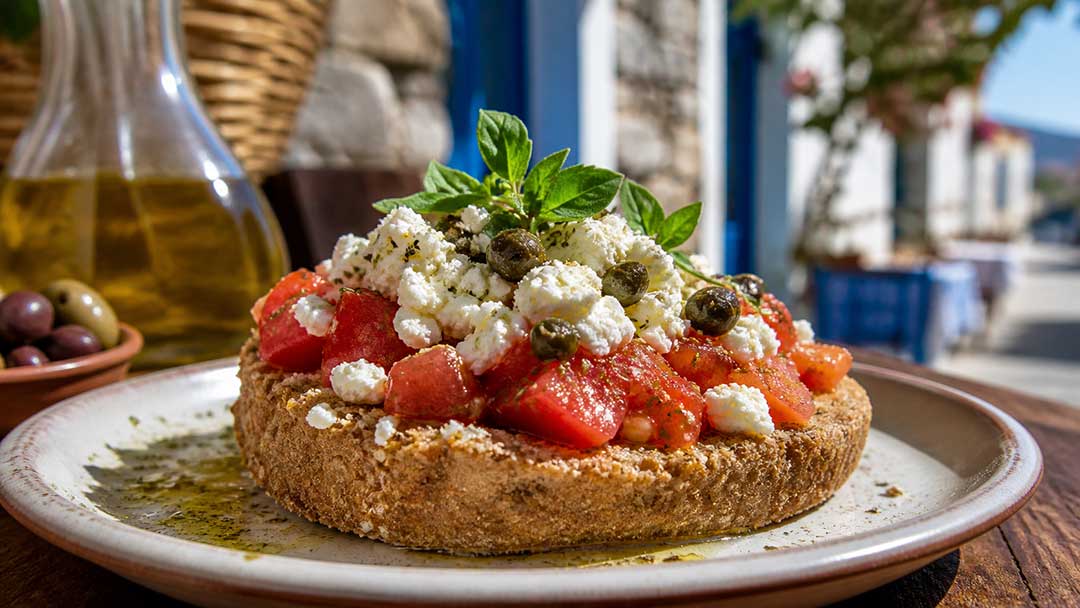
TL;DR: Dakos Crete is a Cretan open sandwich built on a twice-baked barley rusk softened with tomato juice, then topped with grated tomato, mizithra or feta, olives and olive oil. Simple, room-temperature, and better than it has any right to be.
Dakos Crete is one of those dishes that makes you question how much effort cooking actually needs. It is a barley rusk, a tomato, some cheese, a drizzle of oil. And yet, assembled with any care at all, it is genuinely one of the better things you can eat when the afternoon heat has reduced your appetite to something theoretical.
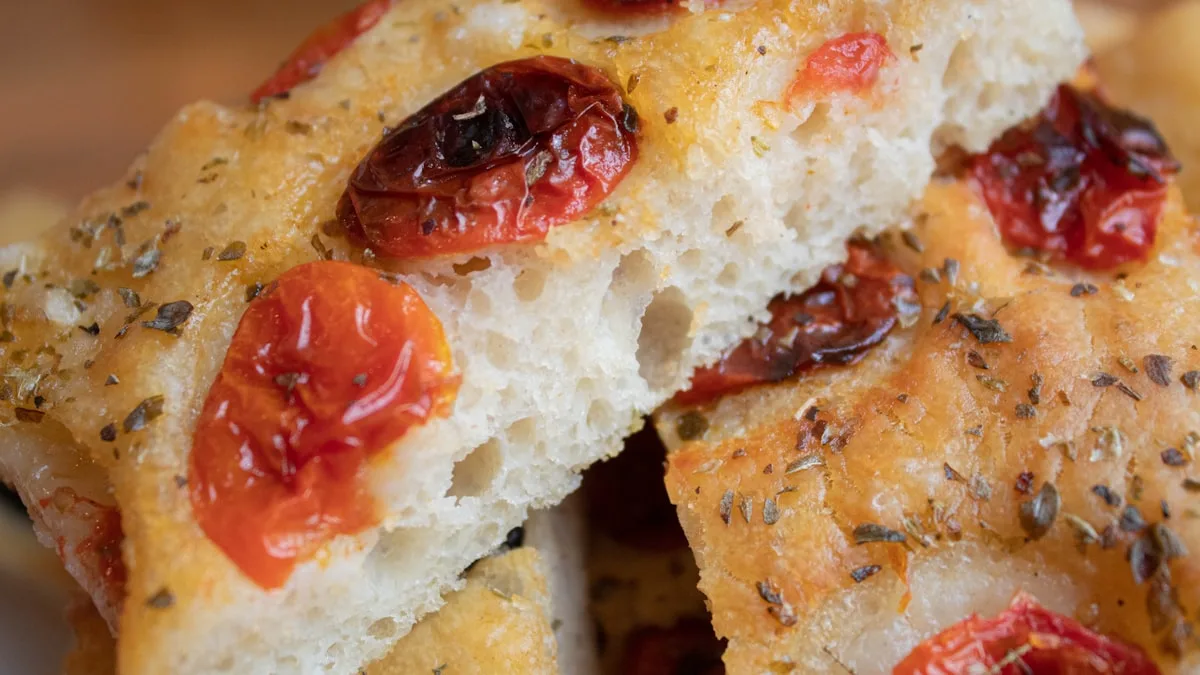
Dakos is a Cretan open sandwich built on a paximadi, a twice-baked barley rusk that is, in its dry state, almost aggressively hard. You would not bite into one without water nearby. The rusk gets softened slightly with water or the juice of a tomato before being piled with grated or crumbled tomato, mizithra or feta, a few olives, dried oregano, and a generous pour of olive oil. The result is eaten at room temperature, usually at lunch.
The name itself comes from the ancient Greek word diakopto, meaning to cut through or break apart, which is a reasonable description of the effort involved in eating an unsoftened one. In Crete, you will also hear it called koukouvagia, meaning owl, for reasons that nobody has ever explained to me satisfactorily. Some things on the island resist easy translation.
The Cretan barley rusk is not a culinary affectation. It came out of necessity. Crete’s terrain is mountainous and dry, its growing seasons constrained, and for centuries its population had to eat in ways that extended the life of grain as far as possible. Twice-baking bread removes almost all moisture, which means it keeps for months without refrigeration. Sailors took it to sea. Shepherds carried it into the hills. It was, essentially, an edible storage solution.
Barley, rather than wheat, was used because it grows more easily in Crete’s terrain and was historically more affordable. The resulting rusk is denser and slightly more bitter than a wheat equivalent, with a nutty depth that softer bread simply does not have. Once you soften it with tomato juice and olive oil, that density becomes a quality. It absorbs without disintegrating. It holds its structure while turning tender at the edges, with a slightly chewy centre. It behaves more like a canvas than a crouton.
The frugality behind the rusk is the point. Crete has a long tradition of cooking that treats scarcity as a design constraint rather than a problem. When you cannot waste anything, you develop techniques that make the most of what survives. The rusk is the physical result of that thinking.
The mizithra tomato rusk combination is where dakos earns its reputation. Mizithra is a fresh Cretan whey cheese, mild and slightly grainy, somewhere between ricotta and a young feta in texture. It melts slightly when it meets the tomato juice and oil, settling into the rusk’s surface rather than sitting on top of it. If you cannot find mizithra, feta works, though it brings a sharpness that changes the balance of the dish.
The tomato is not decorative. It is the liquid component that does the softening work, and its quality is therefore not optional. A watery supermarket tomato produces a bland, soggy result. A ripe, dense, sun-grown tomato produces something that tastes like concentrated summer. Crete grows very good tomatoes, partly because the island’s dry heat concentrates sugars in a way that cooler, wetter climates cannot replicate. This is one reason dakos travels less well than its recipe suggests it should.
The olive oil is the other non-negotiable. Crete produces more olive oil per capita than almost anywhere else in Greece, and the oil from Cretan trees tends to be grassy and slightly peppery, with a finish that lingers. You use enough of it that it pools slightly in the rusk’s surface. This is not the place for restraint.
This is a dish that rewards sequence more than technique. The order in which things happen matters.
There is a version with capers that is excellent and a version with a soft-boiled egg that is slightly more substantial and works well as a light supper. Both are departures from the original, but sensible ones.
What the Greek open sandwich form gets right is proportion. There is no top slice of bread absorbing oil and tomato juice and becoming irrelevant. Everything is visible, every component in the right ratio. You can see what you are eating before you eat it, which is a more useful quality in food than it sounds.
I ate dakos for the first time at a table outside a kafeneion in a village above Elounda, on a day when it was probably thirty-seven degrees and the idea of a hot meal was genuinely offensive. It arrived without ceremony, on a white plate, looking like very little. It was not very little. The rusk had been softened just enough, the tomato was almost obscenely ripe, and the oil had been applied by someone who understood the dish. I ate it slowly, which is not how I normally eat anything, because it deserved the attention.
The principle at work is one that Cretan cooking applies broadly: a small number of excellent ingredients, treated with good judgement, will outperform a more complicated dish made with average ones. This is not a radical idea. It is, however, one that requires actual discipline to follow, because complexity is easier to hide behind than simplicity.
Yes, and most people outside Crete will need to. Feta is saltier and sharper than mizithra, so use slightly less of it and balance with a little extra oil. The texture will be slightly more crumbly rather than creamy, but the dish works well.
Barely at all. A thirty-second wetting on both sides is usually sufficient before the tomato takes over the softening. Over-soaking makes the rusk collapse and the dish loses its structure entirely. The point is a rusk that is tender in parts but still has some resistance.
The comparison is obvious but slightly misleading. Bruschetta uses toasted fresh bread, which means it softens quickly and needs to be eaten fast. Dakos uses a twice-baked rusk that holds its structure for longer and has a more complex, bitter-nutty flavour base. The assembly logic is similar; the eating experience is quite different.
Greek delis in London, Manchester, and other cities with sizeable Greek Cypriot communities usually stock them. Several online retailers specialising in Greek food also sell them. They keep for a very long time in a sealed bag, so buying in bulk makes sense.

At Med.kitchen, our passion lies in crafting exceptional culinary experiences through our online platform. We specialise in sharing a wealth of knowledge via articles, recipes, courses, and online mentoring, aiming to inspire both novice and seasoned chefs alike. Our focus has shifted from private dining to being an online source of gastronomic inspiration, allowing you to explore and refine your culinary skills from the comfort of your home..