
TL;DR: Shakshuka origin points most credibly to North Africa, particularly Tunisia, but the Ottoman Empire spread spiced egg dishes across a vast region. The arguments are as much about national identity as culinary history.
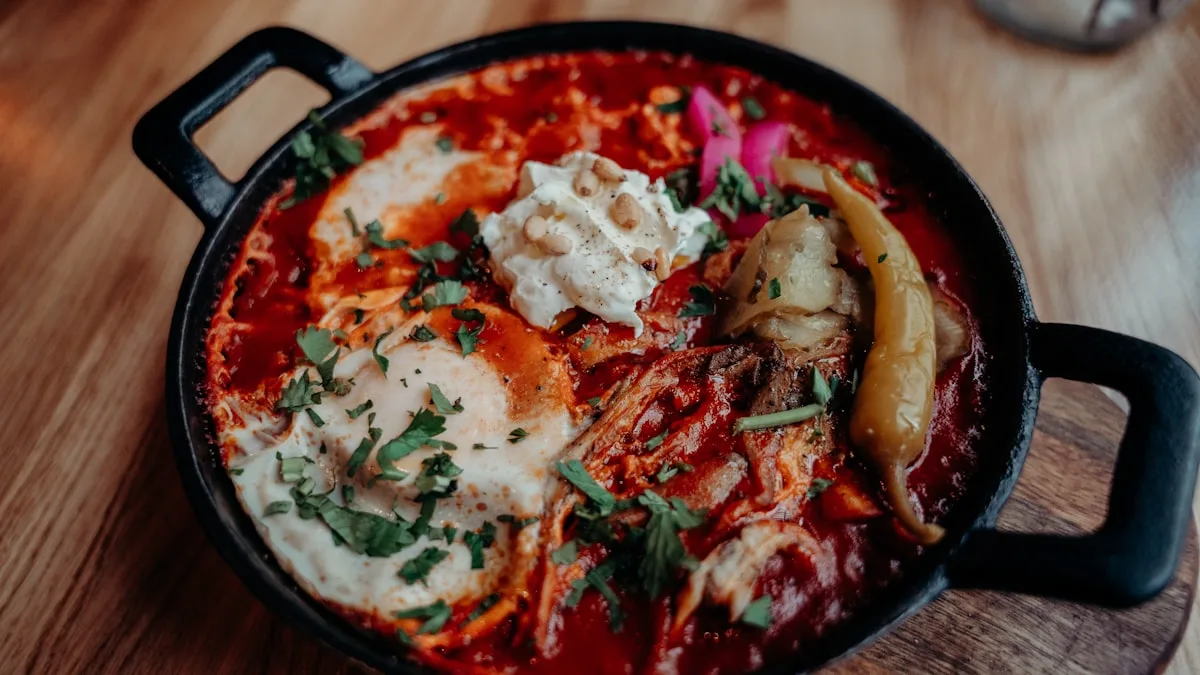
The shakshuka origin question sounds simple until you actually try to answer it, at which point you will encounter passionate Tunisians, equally passionate Israelis, and at least one Turkish grandmother who insists she invented it. The dish itself is straightforward: eggs poached in a spiced tomato sauce, usually eaten straight from the pan. The history behind it is considerably less tidy.
The most credible origin points to North Africa, specifically the Ottoman province that covered present-day Tunisia, Libya, and Algeria. The word ‘shakshuka’ itself likely derives from the Maghrebi Arabic or Berber verb meaning ‘to shake’ or ‘to mix’, which fits the technique reasonably well. Harissa-spiked tomato bases are deeply embedded in Tunisian cooking, and the dish bears a strong resemblance to several traditional Tunisian preparations that predate its Israeli popularity by a good margin.
That said, the Ottoman Empire sprawled across enormous territory for several centuries, and food moved with people. Spiced egg dishes cooked in tomato or pepper sauces appear in Turkish, Egyptian, and Yemeni culinary traditions too. Pinning a dish like this to a single country of origin is genuinely difficult, and anyone who tells you otherwise with total confidence is probably working from national loyalty rather than culinary history.
Tomatoes are the thing people forget. The core ingredient in any traditional shakshuka recipe only arrived in North Africa and the Middle East after the Columbian Exchange brought New World crops to the Old World via Spanish trade routes. That puts the earliest possible version of shakshuka as we know it somewhere around the 16th or 17th century at the absolute earliest, and more realistically later. Pre-tomato egg dishes existed, certainly, but they are a different thing.
This matters because it collapses the idea that shakshuka is some ancient dish with millennia of history. It is relatively modern. The spice profile, the technique, and the communal pan-based serving style are old; the tomato sauce is not. Separating those two facts helps explain why so many different cultures have a plausible claim: the underlying method is widespread, and the tomato sauce layer was added independently in several places around roughly the same era.
Jewish Tunisian and Libyan immigrants brought shakshuka to Israel in significant numbers after the founding of the state in 1948. It spread widely there and became closely associated with Israeli breakfast culture, particularly through cafes and home kitchens in cities like Tel Aviv. That association stuck in Western food media, partly because Israeli cuisine received considerable coverage from the late 2000s onwards, and the dish was often presented without much context about where it had come from before it arrived.
The argument about shakshuka sits inside a much wider tension around food ownership in the region. Hummus, falafel, and baklava have all generated similar disputes, each one touching on questions of identity, displacement, and cultural erasure that go well beyond whether a recipe tastes authentic. When Tunisians see shakshuka described as an Israeli dish in a London brunch menu, there is something legitimately frustrating about that, even if no individual chef intended any harm.
The counterpoint, which is also fair, is that cultures have always adapted, refined, and popularised dishes that came from somewhere else. Italy did not invent tomatoes either. The version of shakshuka that became globally popular through Israeli cuisine is a specific, coherent thing with its own characteristics: often milder than Tunisian versions, sometimes varied with feta or spinach, and plated in ways that make it photogenic on a brunch table. That is a real cultural contribution, even if it is not the origin.
The more honest framing is probably this: shakshuka is a North African dish that travelled to Israel with Mizrahi and Sephardic Jewish communities, was absorbed into Israeli food culture, and was then introduced to European and American diners largely through that Israeli context. Each stage of that journey involved real people and real communities. Flattening it into a single national identity loses all of that.
Strip away the brunch-menu variations and a traditional shakshuka recipe is quite specific. The base is a cooked-down sauce of tomatoes, onions, garlic, and peppers, seasoned with cumin, paprika, and chilli. In Tunisian versions, harissa does most of the work and the result is considerably hotter than what you typically find in Western cafes. The eggs go in whole, the pan goes on a moderate heat, and you wait until the whites are set but the yolks are still loose.
Bread is not optional. The sauce is the point, and scooping it up with a torn piece of khobz or pita is how you actually eat it. I once made the mistake of serving shakshuka at a dinner party with a side salad and no bread, which generated a gentle but persistent silence from one Tunisian guest that I still think about. She was right. The bread is structural.
Modern variations include adding merguez sausage, chickpeas, or preserved lemon, all of which are legitimate within North African cooking traditions. The versions that add cream, goat’s cheese, or kale are doing something different. That is fine, but calling those versions ‘traditional shakshuka’ is a stretch that the dish does not deserve.
Mediterranean egg dishes cooked in sauce are actually a recognisable category, and shakshuka belongs to it alongside things like the Turkish menemen, the Spanish pisto with eggs, and the Italian uova in purgatorio. Each uses eggs, some form of tomato or pepper base, and heat applied from below. They are distinct dishes with distinct flavour profiles, but the structural logic is the same.
This is worth keeping in mind when the ownership debates get heated. The specific combination of North African spices and technique that defines shakshuka is particular enough to have a real identity. But the broader category of ‘eggs cooked in tomato sauce’ is not anyone’s invention. It is what happens when eggs and tomatoes share a pan and someone applies heat.
The shakshuka debate persists because it is not really about the food. It is about which communities get credited for their contributions to global cuisine, and which ones get skipped over when a dish becomes fashionable. That is a legitimate conversation, and it applies well beyond shakshuka. The question worth sitting with is not ‘who invented it’ but ‘who gets erased when we tell the simplified version of the story’.
North African Jewish communities carried this dish across the Mediterranean under circumstances that were not chosen. The fact that it became associated with the destination rather than the origin says more about how food media works than it does about culinary history.
The dish originates in North Africa, most likely Tunisia, and was brought to Israel by Mizrahi and Sephardic Jewish immigrants in the mid-20th century. It became widely known in Western food culture through its association with Israeli cuisine, which is why both descriptions circulate. The North African origin is the more historically grounded one.
The word is most likely derived from a Maghrebi Arabic or Berber root meaning ‘to shake’ or ‘to mix’. Some sources connect it to a colloquial term for a mixture or muddle. The etymology is not definitively settled, but the North African linguistic roots are consistent with the dish’s likely place of origin.
Because it relies on tomatoes, shakshuka as we know it cannot predate the 16th century at the earliest, when tomatoes arrived in North Africa via the Columbian Exchange. The spice traditions and egg-cooking techniques that define it are older, but the tomato-based dish itself is a relatively recent development in culinary terms.
No. Menemen is a Turkish dish that scrambles the eggs into the tomato and pepper mixture rather than poaching them whole. The base ingredients overlap, but the technique and texture are different. Both belong to the broader category of Mediterranean egg dishes cooked in sauce, but they are distinct preparations with distinct identities.

At Med.kitchen, our passion lies in crafting exceptional culinary experiences through our online platform. We specialise in sharing a wealth of knowledge via articles, recipes, courses, and online mentoring, aiming to inspire both novice and seasoned chefs alike. Our focus has shifted from private dining to being an online source of gastronomic inspiration, allowing you to explore and refine your culinary skills from the comfort of your home..