
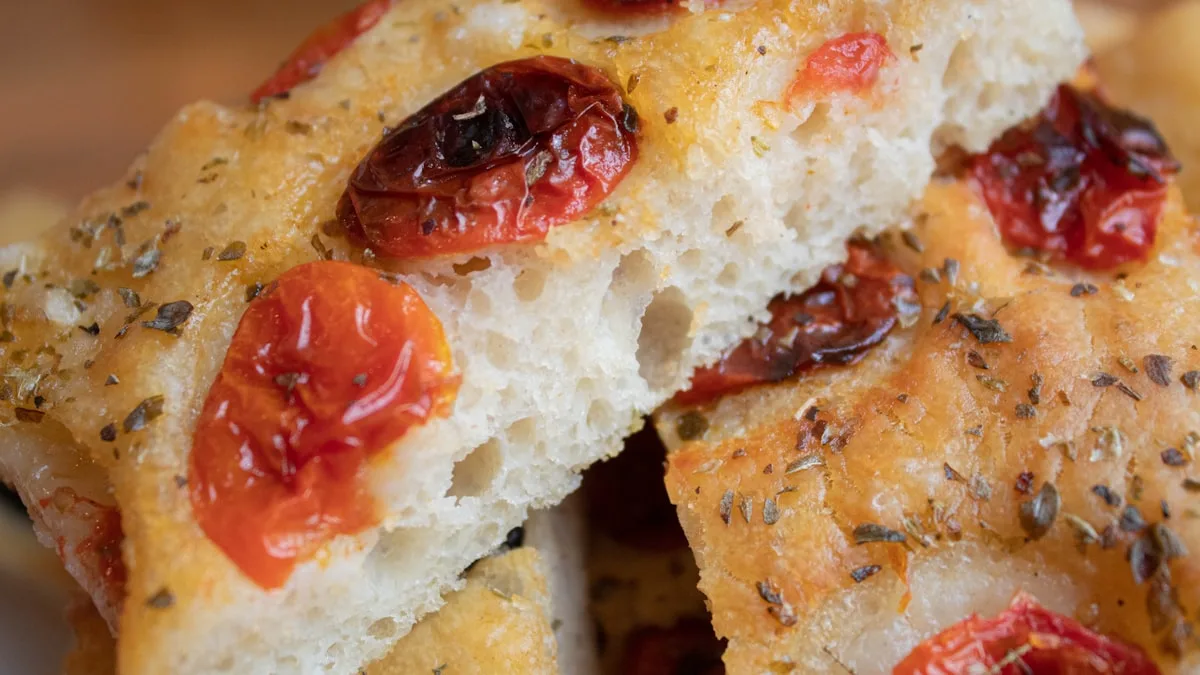
TL;DR: Mediterranean flatbread baking covers distinct regional traditions, not variations on one idea. Sfincione, focaccia and pizza bianca differ in dough, topping and technique. Slow fermentation is central to getting each one right.
Mediterranean flatbread baking is older than most cuisines it has influenced, and yet people are only now beginning to treat it with the seriousness it deserves outside its home regions. Sfincione from Palermo, focaccia from Liguria, pizza bianca bread from Rome: these are not variations on a theme. They are entirely separate traditions that happen to share flour, water and fire.
I should be honest about something. For years I lumped all of these together under a vague mental category of ‘Italian bread things’. It took eating a proper sfincione at a street stall in Palermo, still warm and heavy with tomato and onion, to understand how wrong that was. It bore no resemblance to focaccia. It was thicker, denser, almost cake-like in its sponge. The comparison felt immediately embarrassing in retrospect.
The term ‘flatbread’ is deceptive. It implies something thin and simple, a piece of unleavened dough cooked fast over high heat. But traditional Italian flatbreads sit on a spectrum that includes thick, yeasted slabs that take hours to prove and reward patience in ways that a ten-minute pitta does not.
Sfincione, focaccia and pizza bianca share a leavened base, but each has a distinct character shaped by its region’s ingredients and its people’s habits. Sfincione uses a soft, enriched dough topped with tomato, onion, anchovies and caciocavallo cheese. Focaccia relies on olive oil, often in quantities that feel reckless, to produce its characteristic open crumb and glistening surface. Pizza bianca is simpler still: olive oil, salt, rosemary, and a dough left alone long enough to develop real flavour.
Understanding these as separate forms, rather than as versions of the same thing, is the starting point for baking any of them well.
What these breads share, more than any ingredient, is time. Slow fermentation bread is not a trend imported from sourdough culture. It is the original method. Bakers in Liguria and Sicily did not rush their doughs because they had no reason to. Commercial yeast did not exist. Wild fermentation was the only option, and the results were structurally and flavouristically superior to anything achieved by speed.
A focaccia slow rise, typically twelve to twenty-four hours in the fridge after an initial room-temperature prove, allows the gluten to relax properly and the dough to develop acidity and depth. When you press your fingers into the dough before the final bake, those dimples hold because the structure is strong but extensible. Rush the process and the dough springs back, the surface stays smooth, and the result tastes flat despite looking correct.
Pizza bianca bread follows the same logic but goes further. Many Roman bakers use seventy to eighty percent hydration doughs, which are difficult to handle but produce a web-like crumb once baked. The long cold fermentation makes this workable: a well-rested high-hydration dough is far easier to shape than one that has been hurried. The slow process solves the technical problem as well as the flavour one.
A proper sfincione recipe starts with a soft dough, often made with semolina or a blend of semolina and plain flour, hydrated to around sixty-five percent. The dough is proved slowly, pressed into an oiled tin, and then left to rise again before topping. This double prove is not optional. It is what gives sfincione its distinctive spongy base, which needs to support a relatively heavy topping without collapsing into grease.
The topping itself is worth pausing on. Palermitan sfincione uses a slow-cooked tomato and onion sauce that is deliberately unsmooth, scattered with breadcrumbs fried in anchovy oil, and finished with grated caciocavallo. The breadcrumbs are not garnish. They absorb moisture during baking and create a texture between crisp and soft that is entirely unlike anything you get on a pizza.
There is also a white version, sfincione bianco, which skips the tomato in favour of onion, ricotta and breadcrumbs. Less known outside Sicily, arguably more interesting once you try it. The restraint forces you to pay attention to the dough itself.
Focaccia and pizza bianca bread are often treated as interchangeable by anyone who has not baked both seriously. They are not. Focaccia from Genoa is thick, oily and dimpled, baked in a pan, and eaten as bread alongside a meal or on its own. Pizza bianca from Rome is thinner, crisper at the edges, torn rather than sliced, and designed to be eaten immediately. It does not improve with time. Focaccia does.
The olive oil quantity in a proper Ligurian focaccia would alarm most home bakers. It goes into the dough, it pools in the dimples before baking, and it is added again after the bread comes out of the oven. This is not indulgence for its own sake. The oil coats the gluten strands, limits excessive chew, and keeps the crumb moist for longer than a standard bread would manage.
Pizza bianca relies on a different technique: a very wet dough, baked at high heat on a stone or steel, with just enough oil to prevent sticking and to blister the surface. The goal is a thin cracker-like base in the middle with a puffed, bubbly perimeter. Getting this right at home requires a properly preheated oven and the confidence to work with a dough that feels closer to batter than to bread dough.
There is something genuinely interesting happening in British home baking right now. The focaccia slow rise method has crossed borders without being diluted. People are making twelve-hour cold-fermented focaccia in Leeds and Edinburgh, using good olive oil and sea salt, and producing something credible. The technique translates because it relies on biology, not geography.
What gets lost in translation is usually ingredient quality and, less obviously, ambient temperature. A dough left to prove overnight in a warm Sicilian kitchen behaves differently from one in a British kitchen in February. These are not insurmountable problems. They are calibration issues. Adjust the yeast quantity, adjust the timing, and the results follow.
Sfincione has been slower to travel, partly because caciocavallo cheese is still not easy to find outside Italian delis, and partly because the bread is so specific to its context that it resists casual recreation. But that specificity is exactly what makes it worth seeking out, as a starting point for understanding how Mediterranean baking techniques produce results through patience rather than formula.
Sfincione uses a thicker, softer dough that proves twice before baking. The topping is cooked separately before it goes on the bread, and the breadcrumb layer is integral to the texture rather than decorative. Regular pizza is baked at higher heat for a shorter time, producing a crisper base. Sfincione is more like a bread than a pizza in structure and eating experience.
A minimum of twelve hours in the fridge after an initial two-hour room-temperature prove is a reliable baseline. Many bakers extend the cold fermentation to twenty-four hours without any problem, and the flavour continues to develop across that time. Shorter proves produce bread that is technically acceptable but noticeably less complex in flavour.
Yes, with adjustments. A domestic oven needs to be preheated to its maximum temperature with a heavy baking tray or pizza steel inside for at least forty-five minutes. The dough should be slid onto the hot surface rather than placed gently. The result will not be identical to a wood-fired version, but it can come close enough to be worthwhile. High heat and speed are more important than the oven type itself.
Focaccia, particularly the Ligurian style, is thick, heavily oiled and baked in a pan to produce a soft, chewy crumb. Pizza bianca is thinner, crisper, and baked directly on a hot surface. Focaccia holds well for a day or two after baking. Pizza bianca is best eaten within an hour of coming out of the oven, as it loses its texture quickly once cooled.
The real question is not whether these breads can be made well outside their home regions. They clearly can. The question is whether, once you understand what separates them, you still want to treat them as interchangeable. Most people who have eaten sfincione from a Palermo street stall and focaccia from a Genovese bakery on the same trip would say no. The difference is not subtle once you know what to look for.

At Med.kitchen, our passion lies in crafting exceptional culinary experiences through our online platform. We specialise in sharing a wealth of knowledge via articles, recipes, courses, and online mentoring, aiming to inspire both novice and seasoned chefs alike. Our focus has shifted from private dining to being an online source of gastronomic inspiration, allowing you to explore and refine your culinary skills from the comfort of your home..